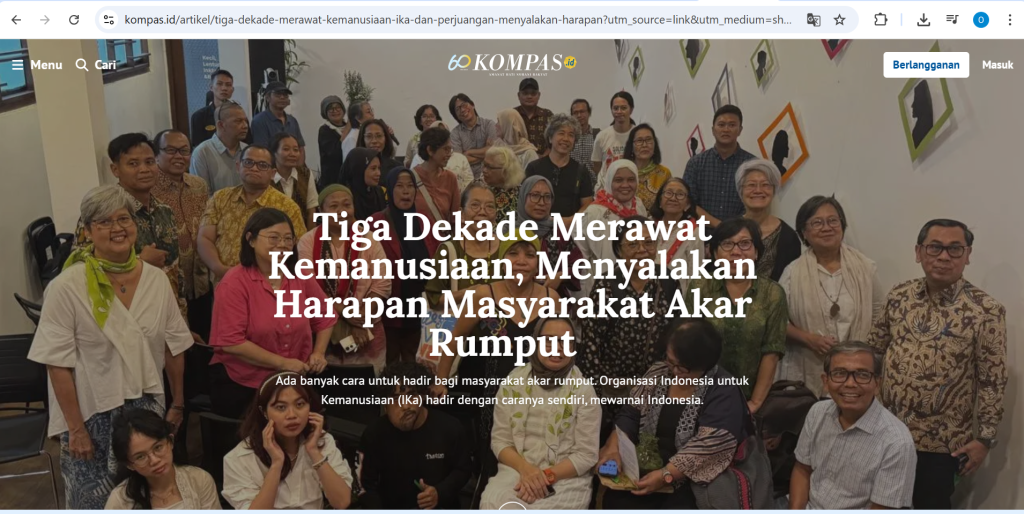
Suasana hangat dan penuh keakraban menyelimuti sebuah ruang di Jalan Cikini Raya, Jakarta Pusat, Selasa (28/10/2025) lalu. Puluhan aktivis dari beberapa generasi hadir di ruangan yang dikenal dengan Ke:Kini Ruang Bersama—salah satu ruang kerja bersama atau co-working space di tengah deretan bangunan kuno di daerah Cikini.
Kehadiran mereka, petang itu, bukan sekadar untuk bernostalgia, melainkan merayakan sebuah perjalanan panjang, yakni 30 tahun Indonesia untuk Kemanusiaan (IKa) dalam merawat solidaritas dan menyemai keswadayaan. Sebuah lembaga yang tumbuh dari jalan kecil dan sunyi, tetapi melahirkan arah dan kemandirian.
Grants play a critical role in the civil society space internationally. both Grants locally enable and local initiatives to address issues related to social injustices, environmental human rights and sustainability. Non Governmental Organizations (NGOs) in Indonesia are highly dependent on grants from foreign aid donors to fund their initiatives due to limited domestic funding opportunities. This has caused high international donor dependency and limited funding diversity among Indonesia’s NGOs, which has serious implications for Indonesia’s civil society space.
Due to limited donor diversity, Indonesia’s NGO sector must compete for international funding, causing power imbalances between donors and grantees. Understanding the power relationships between donors and grantees is necessary for developing a strong civil society structure in Indonesia. Developing a strong civil society structure in Indonesia requires shifting the power from large foreign donors to local communities by prioritizing ‘people-led development’ focused on the strengths of local communities.
On Friday the 31st of January 2025, IKa hosted the 9th forum for transformative resources alongside other local and international NGOs to discuss shifting the power movement, aimed at understanding donor-grantee relationships in the civil society sector. The meeting included members from the Samdhana Institute, MAF Indonesia, Peace Direct, Komunitas Ibu Jamu, and individuals concerned about transformative resources, all providing valuable insights into the shifting power movement.
All members agreed that understanding the drivers of unequal power relations in the grant space is essential to increasing independence in the civil society space. Martua from the Samdhana Institute discussed the ‘Cubic of Power’ to help analyse the three dimensions of power, these being spaces of power, levels of power and faces of power (see figure 1). Applying the ‘Cubic of Power’ can support NGOs in understanding the most appropriate strategies for shifting the power. Siti from MAF Indonesia, highlighted the importance of knowledge production for shifting the power to address issues related to poverty and the ecological environment. With reference to the ‘Cubic of Power’ this requires a created space of power, allowing for local level involvement by sharing their traditional knowledge.
This contrasts with top-down donors who hold a closed space of power characterized by closed-door meetings that exclude local involvement and knowledge production, also known as the dominant system.
Unequal power relations between donors and grantees are a characteristic of the dominant aid system which mirrors aspects of colonialism. For example, donors exert their power to control how grantees must use their funding. Regina from Peace Direct highlighted how the entire aid system is set up for local and community organizations to fail; donor dependency is a reflection of this. Moving away from the dominant system to what is called the emergent system is essential for shifting the power.
Emergent systems such as shifting the power can decolonize traditional aid systems and redistribute power into the hands of local communities, allowing grantees to determine how they use their funding in accordance with their community values and strengths. IKa applies the term ‘Akar Daya’ which translates to ‘community rooted potentials’, an important component to shifting the power by focusing on the unique strengths of communities to address challenges they may face.
When local communities hold the power, they increase their independence and ability to address oncoming challenges without relying on external funding.
Increased NGO independence is especially important in relation to the newly elected US prime minister. On the recent day of inaugaration, US President Donald Trump introduced a 90-day pause on all US foreign development assistance. At present, USAID (the world’s number 1 provider for humanitarian aid) is no longer in operation, meaning over $60 billion worth of programs supporting vulnerable people have now stopped. According to the US secretary of state Marco Rubio, the pause on foreign aid aims to assess whether the programs supported USAID align with US priorities. The uncertainty surrounding the pause is placing NGOs in a vulnerable position, particularly in countries such as Indonesia that heavily dependent on foreign aid. Now more than ever, there is a sense of urgency among civil society groups to decolonize the dominant aid system so local communities can regain their power and funding independence.
Regina provided examples of international initiatives that are attempting to decolonize traditional aid, one being the Latin American Permanent Forum on Decolonized and Antiracist Aid. The forum acts as a permanent space that brings together and educates actors who are committed to making international aid more equitable and democratic while benefiting all parties involved.
Implementing donor education can help prevent unequal power relations between donors and grantees. Shifting the power in the donor-grantee spaces does not call for an end to foreign aid but rather encourages participation from all actors involved and prioritizes the needs and unique strengths of grantees.
The forum hosted by IKa successfully highlighted the different approaches to shifting the power to increase independence in the civil society sector. Understanding donor-grantee relationships independence to must improve be a NGO priority, particularly after the recent US election results. The forum established the importance of knowledge sharing between NGOs when discussing shifting the power movement, as each organization or individual holds their own view or experience that may benefit others.
As an intern myself at IKa, the forum for transformative change deepened my understanding of the shifting power movement. I could feel the passion and urgency among forum participants to improve NGO and civil society independence particularly after the recent US election results. I believe now more than ever the civil society sector must increase their independence and embrace Akar Daya so communities can continue to thrive, no matter what the future of foreign aid holds. Whilst the situation in the US is far from ideal, it can be seen as motivation for more communities to reflect on their unique strengths and traditional knowledge in addressing various obstacles they may face.
I hope to share my newfound knowledge on the shifting power movement in Australia with my university when I return. Shifting the power is particularly important for Australia’s Aboriginal peoples who have been continually oppressed. The traditional knowledges and practices held within the Aboriginal community has the potential to manage a variety of environmental, economic and social challenges within Australia if they were provided with the power to implement their own ‘Akar Daya’.
???? Bumi, Sejarah, dan Kita: Membaca Ulang Nusantara dalam Krisis Iklim Bagaimana jejak sejarah dan kearifan lokal Nusantara bisa memberi arah di tengah krisis iklim hari ini? Mari bersama membaca ulang relasi manusia dan alam dari perspektif budaya, spiritualitas, dan ekologi Nusantara bersama Hilmar Farid, PhD. Ketua Senat IKJ
Waktu: ???? Selasa, 29 Juli 2025 ⏰ Pukul 14.00–16.00 WIB Hybrid: ????Luring: Ke:Kini Ruang Bersama Jl. Cikini Raya No.43/45, Cikini, Menteng, Jakarta Pusat (bertempat di lt.2, hanya bisa diakses melalui tangga)