


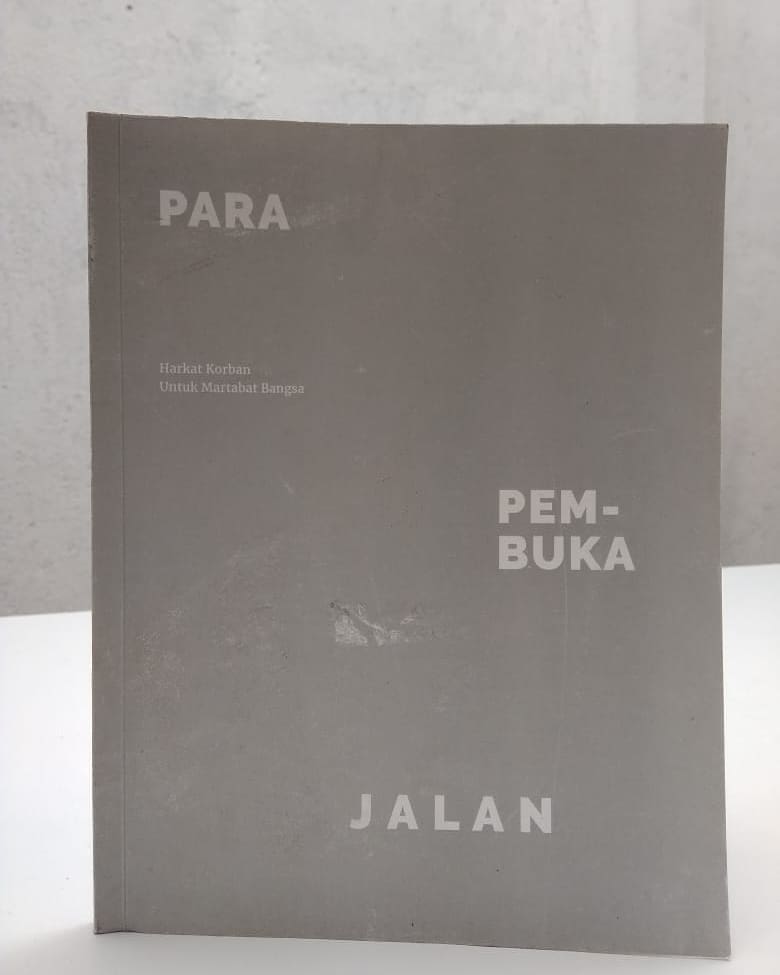
The Pathfinders is a non-fiction photography book which recounts the life journey of victims of past gross human rights violations. The book is published by Indonesia for Humanity (IKa) with support from The Asia Foundation via the Peduli Program. This 106-page book was published in August 2019 and is filled with photographs with accompanying text written by Lilik HS of Pundi Perempuan, IKa
This photo-book is a portrait of the lives of the victims/survivors today, and their road to rehabilitation with victim support communities and the public.
The first section contains images of couples, of husbands and wives. What is special about this? These couples are just some of the thousands of couples that from 1976 right up until the signing of the peace agreement in 2015 were victims of the conflict in Aceh. During this period, many marriages were unofficial because the conflict disrupted government services, with the greatest impact felt by people living in the interior of the province. As a result, many couples do not possess marriage certificates, which means in turn that their offspring are unable to access government services. “Our life was disrupted, we were not acknowledged by the state,” said Hasan Ajad and Halimah, one of the couples that were victims of the conflict.
The second section recounts the feelings of vengeance and uncertainty that have accumulated over the years, and the opportunity that the victims/survivors eventually found to make peace with themselves and with their communities. A traditional ceremony held at village level provided the first small step and opened up the space for recognition and dialogue between the perpetrators and the victims of the events that took place 54 years ago during the 1965/66 political tragedy.
It’s not only the victims that are shrouded by grim shadows; the families of the perpetrators are also covered by a feeling of guilt and the social burden of the mass killings that their relatives perpetrated. Because of the traditional ceremony, they are now able to build their lives again with greater peace and without the burden of the past.
This book also describes one of the state’s rehabilitation initiatives for victims of past gross human rights abuses, namely the ‘green book,’ in a chapter entitled “Medical and Psychological Support Provision from the LPSK.” The ‘green book’ is a document issued by the Witness and Victim Protection Agency (LPSK) to victims who have obtained the ‘Victim Information Document’ known as Sukket from the National Commission for Human Rights (Komnas HAM). This document enables victims to receive free medical services and support in accessing medical services.
“This enables me to get free treatment. The state pays,” said Wahyono (76) whilst showing his Sukket from Komnas HAM to one of the customers at his satay stall. He set up his stall in front of his house and with this document he is able to receive free medical treatment. The injuries he suffered to his legs due to torture were x-rayed and treated. Now, he no longer feels pain every day. In 1965 he was a civil servant working in the Surakarta Municipal Hall who was accused of being a member of a outlawed organization and arrested.
The next chapter recounts how weaving became a source of income and life support for women in Sigi whose husbands had been arrested and imprisoned. The Victims of Human Rights Abuses Solidarity organization (SKP-HAM) in Central Sulawesi promoted a return to weaving as part of their efforts to organize the victims/survivors, as weaving is part of who they are.
The many interesting photographs in this book try to show the optimism of the pioneering efforts made to fulfill the economic, social and cultural rights of victims and survivors of past gross human rights violations. These efforts are based on hard work to prevent the repetition of human rights violations in the future and to safeguard the humanity of the Indonesian people.