


In the corridors of the Faculty of Sociology and Politics of Sebelas Maret University (UNS), a number of students are entranced by row upon row of photographs exhibited there. The photographs tell the stories of victims and survivors that still struggle to navigate the difficult path to justice and equal access to the benefits of development. Seven narratives from seven different regions are recounted through those photographs, from North Aceh, to East Lampung in Sumatra, from Jakarta and Surakarta on the Island of Java to Palu in Central Sulawesi and Sikka in Flores.
These photographs recount stories that very few students are already aware of. Stories of sweat, tears and bloodshed, stories that can be told in many ways in order that they be passed on to future generations. Not least to ensure that these tragedies are never repeated.
One of the stories that has drawn a lot of attention is entitled When the State Says Hello, which tells the experience of the victims of the 1965 political tragedy in Surakarta, the story of the survivors that have obtained access to medical and psychological care from the Witness and Victim Protection Agency (LSPKK) following receipt of Victim Information Document from the National Commission for Human Rights (Komnas HAM). The ‘Green Book’ that they receive from the LSPKK not only enables the victims and survivors to access healthcare, but is also a sign that the state has acknowledged their plight and is treating them in the same way as other citizens.
Many people say that the youth of Indonesia have forgotten about gross human rights violations, but that doesn’t seem appropriate. It’s not that they have forgotten, it’s that they have not been made aware in the first place as many past human rights abuses have not been revealed to young people.
“Honestly, I am only just finding out about gross human rights violations, that these events are part of my life as a student. And this is only because I have been active in various discussions that have been held by my organization. I am fortunate, but what about other young people who aren’t as lucky as me,” said Erma Alfionita, Head of the UNS Sociology Students Association.
It is an open secret that the youth have been force-fed a historical narrative created by the government, particularly previous governments. This narrative does not talk of the humanitarian tragedy from the perspective of victims and what they have been subjected to. There has been no comprehensive discussion in school history books.
It is important to bequeath these stories to young people in order that past tragedies are not repeated, so that those that are still missing or who have died are not forgotten. Efforts to raise awareness about human rights are being developed in a range of diverse ways and by many different parties, including youth groups, artists, academics, cultural organizations and victim/survivor groups. This is one of Indonesia for Humanity’s (IKa) areas of work by collaborating with and providing support to victim/survivor groups and other civil society organizations (CSOs) with the Peduli Program.
The Peduli Program works on poverty eradication with an inclusive development approach that ensures that marginalized communities are able to participate in and benefit from development. Indonesia for Humanity acts an umbrella organization for the victims of gross human rights violations including: Victims of the Military Operational Region policy in Aceh, Victims of the 1965/66 humanitarian tragedy in Yogyakarta, Surakarta and Sikka, Victims of Talangsari-Lampung and Victims of the 1998 riots in Jakarta.
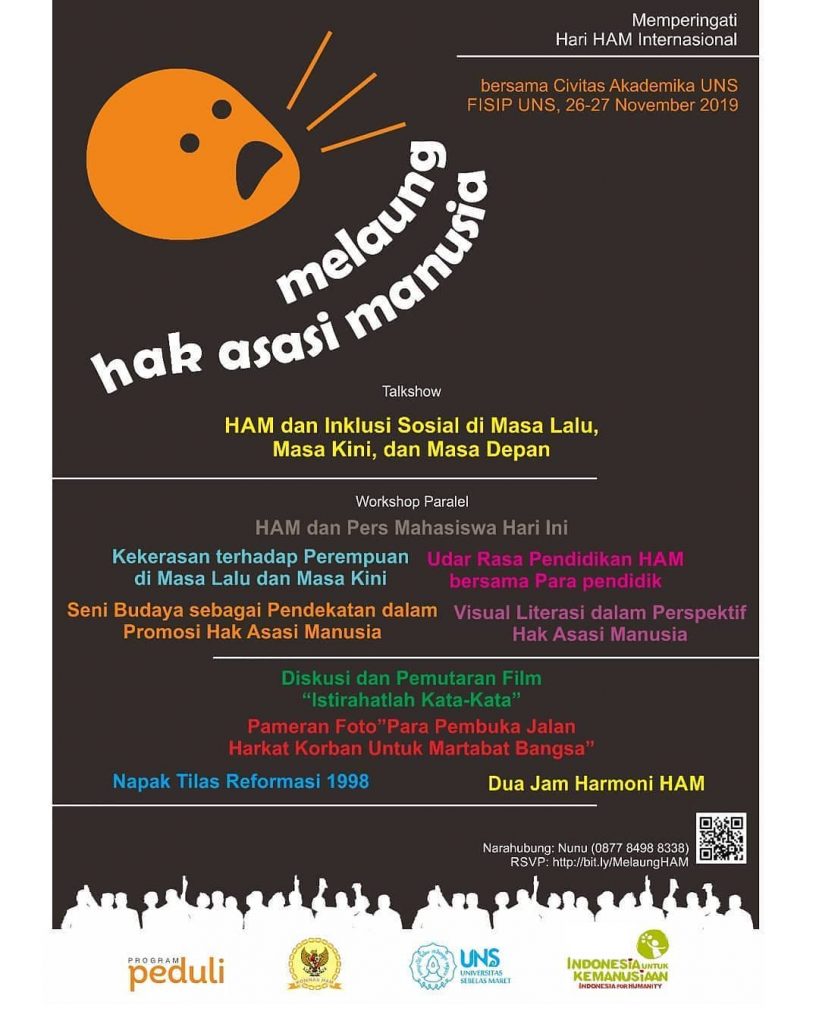
In order to commemorate International Human Rights Day on 10 December 2019, Indonesia for Humanity (IKa) will hold the event, Howl for Human Rights in collaboration with Sebelas Maret University (UNS), and with the support of the Peduli Program. This event will be held on 26–27 November 2019.
In order to attain these aims, Komnas Ham, the UNS Faculty of Sociology and Politics (FISIP) and IKa with the support of the Peduli Program will hold the event, A Howl for Human Rights, together with UNS. This event will take place over two days and will introduce the concepts and practices of human rights and social inclusion to the academic community through activities such as public seminars, parallel workshops, photography exhibition, musical performances and by tracing the history of 1998 political reform.
This event is a follow-up to the signing of an MoU between Komnas HAM and UNS on 1 November 2018. The MoU was signed by the Head of Komnas Ham, Ahmad Taufan Damanik and the Rector of UNS, Prof. Dr. Ravik Karsisi, MS. The two parties agreed to collaborate in order to promote Human Rights on the basis of Indonesian Higher Education’s values of Tri Dharma, and which aims to strengthen the implementation, protection and respect of human rights as well as strengthening institutional synergy between the two organizations.
In addition to sharing the stories of the victims/survivors and to strengthen commitment to resolving human rights issues, this event will introduce the concepts and practices of human rights and social inclusion to the academic community through activities such as public seminars, parallel workshops, photography exhibition, musical performances and by tracing the history of 1998 political reform.
Opening up a Forum for Inter-Generational communication
“We can find out about gross human rights violation from books, but of course it is different if we have the opportunity to meet with and discuss human rights directly with victims and human rights defenders,” said Erma.
Bringing young people together with actors of history is one of the main aims of this event. Opening up a space to meet and discuss is expected to increase the concern of young people towards human rights issues in Indonesia, be they in the past, the present or the future. Inter-generational communication can help heal memory which has perhaps been worn down by the onslaught of old narratives that the government is trying to revive again.
The talk show Human Rights and Social Inclusion in the Past, the Present and the Future aimed demonstrate the fact that human rights are something close to us, something dynamic. So we need materials that help us heal human rights in the midst of the political upheaval of Indonesia today.
Following the talk show, the UNS Faculty of Sociology and Politics and Komnas HAM signed an agreement to collaborate together on the promotion of human rights via a program entitled Howl for Human Rights Together with the Students of Sebelas Maret University. The agreement was signed by the Dean of the Faculty of Sociology and Politics, Dr. Ismi Dwi Astuti Nurheani, M.Si and the Commissioner for Education and Counseling, Komnas HAM, Beka Ulung Hapsara.
Discussion on different approaches to addressing human rights issues was held in a number of parallel workshops, according to individual expertise, from violence against women, cultural approaches to resolving human rights violations, student press and human rights, human rights education and visual literacy in human rights approaches.
A musical performance entitled Dua Jam Harmoni HAM (Two Hours of Human Rights Harmony) provided an example of how the arts, and music in particular, can be used as part of the campaign to increase awareness of human rights issues. The musical program included performance from the UNS Faculty of Sociology and Politics Music Community, Nganthi Wani X, Julian Rinaldi, Sisir Tanah and Bonita & Adoy. The performances provided both entertainment and an opportunity to discuss issues directly with the survivors in attendance, and an opportunity to enjoy the music together.
Istirahatlah Kata-kata, (released in English with the title Solo Solitude), a film that recounts the story of poet-activists from Solo, Wiji Thukul, a victim of forced disappearances in 1997/1998, provided another opportunity for discussion and the exploration of human rights violations in Indonesia. The film’s producer, Yulia Evina Bhara, took part in the discussion, as did Tonny Trimarsanto (a filmaker) and Zaenal Muttaqien (member of IKOHI, Ikatan Keluarga Orang Hilang Indonesia – the Association of Families of the Disappeared).
The last event, Napak Tilas Reformasi 1998 (On the Trail of 1998 Political Reform), provided participants with the opportunity to trace and learn about the locations and events that led to political reform in 1998, and to share stories of these historical events by visiting the actual locations.
“The Napak Tilas event is fantastic because we get to visit these historic locations in Solo. We knew about history from books, but with Napak Tilas we can really learn about history in another way, more directly,” said Naufal Amar, one of the participants.
In addition to the students, five Peduli Program partners also attended A Howl for Humanity, namely the IKOHI Federation, FOPPERHAM (Forum Pendidikan dan Perjuangan HAM – Education and Human Rights Forum), RPuK Aceh (Relawan Perempuan untuk Kemanusiaan – Women Volunteers for Humanity), Central Java Sekber ’65 (Sekretariat Bersama – an organization that represents victims of the 1965 political tragedy) and PBH Nusra (Perhimpunan Bantuan Hukum Nusa Tenggara – Nusa Tenggara Legal Aid Foundation). In addition, a number of survivors from Solo and Yogyakarta took part in the event and shared their stories and experiences.
What Next?
Opening up an inter-generational space for discussion, is like handing over a key to a generation. We don’t know what is going to happen because they have their own imagination. They will use that key to open many doors to a wealth of information. They can invite their friends and share the key to open doors that are stuck in the silence. The can also duplicate the key they have been given and share them further so that these stories will never die.
What happens following the closing of the Howl for Humanity event at UNS is beyond our expectations. According to Erma, many students from the Sociology Department have chosen human rights, specifically past gross human rights violations, as their research topic. Moreover, the Faculty of Culture at UNS decided to host a discussion about past gross human rights violations, involving a number of human rights activists, the following week.