


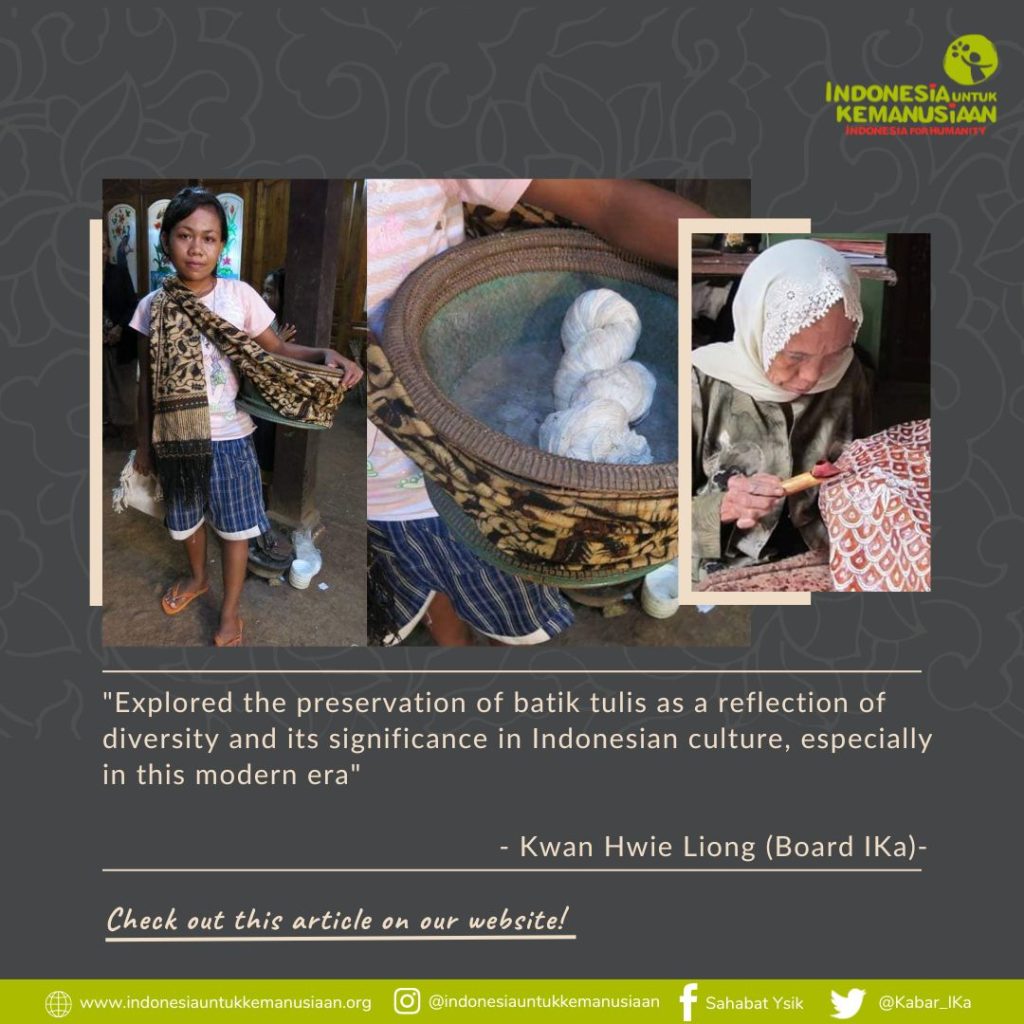
Tulis as a Form of Diversity, Sustainability, and Local Wisdom,” a cultural discussion held last Friday (14/4). The discussion was designed by Humaira Sentosa, Prysafella Deviena, and Tariska Salsabila, three University of Indonesia students currently conducting practicum at IKa. Ngulik Budaya was held online via Zoom and featured Kwan Hwie Liong (William Kwan), the Director of the Institut Pluralisme Indonesia/Institute for Pluralism in Indonesia (IPI) and an observer of batik.
In recent years, there has been a renewed focus on preserving batik tulis as one of Indonesia’s cultural identities. “Ngulik Budaya” emerged as a response to the struggle of batik tulis to remain relevant today. This is because batik tulis now has to compete with fast fashion trends and the demands of the industry for faster and cheaper production methods. William Kwan explored the preservation of batik tulis as a reflection of diversity and its significance in Indonesian culture, especially in this modern era.
William explained that every region in Indonesia has a unique style of batik, reflecting local culture, history, and natural environment. The use of batik is not limited to clothing, as it is also used for various purposes such as decoration and religious rituals. Batik motifs can vary from simple geometric designs to complex narrative scenes, each with its own symbolism and meaning.
The welfare of batik craftsmen is closely linked to the preservation of batik as a cultural heritage. These craftsmen inherit the tradition of making batik designs from their ancestors, and their livelihoods depend on their ability to continue practicing this craft. The emergence of mass-produced textiles poses another challenge for batik craftsmen. Therefore, the sustainability of the batik craftsmen community is also a focus of this cultural discussion.
However, William revealed the reality that most batik makers only receive wages in the tens of thousands of rupiah each month. This is certainly not commensurate with the fact that batik makers are cultural heroes who play an important role in preserving Indonesia’s cultural heritage.
William saw that one reason for the low wages of batik makers is the lack of research to understand the demand and market interest where batik is developed. “Until now, the production of batik and wages at the local level have not been closely related to the larger market, whether in Indonesia or abroad. For example, in Sweden, what do people like, and what pattern are they interested in? If we can understand that, then our batik can have high value,” he said.
In addition, William noted that the low wages of batik artisans could have an impact on the interest of young people in becoming the next generation of batik artisans. Therefore, the government needs to make efforts to map out potential regions for batik’s markets and study the preferences and demands of the markets in those areas. From there, plans can be made to develop batik that can attract young people to get involved in the industry.
Nevertheless, efforts to cultivate an interest in batik can also be initiated even if the government has not yet taken action. One way is to utilize the current trend of young people attending workshops, particularly in urban areas. Workshop organizers can hold classes on batik making. This way, young people not only satisfy their desire to try something new but also participate in cultural preservation. Eventually, when their love for batik has taken root, transforming that passion into a source of income will become more open. “The hope is that batik can become one of the sources of income for young people,” said William.
IKa, as a civil society resource organization, supports the sustainability of batik makers and preservation activists. This cultural discussion is also an invitation to donate through Pundi Budaya, a resource mobilization program by IKa dedicated to supporting artists, activists, and defenders of culture and diversity.
“Specifically at IKa, we have the Pundi Budaya program, so hopefully through proactive activities, we can encourage the preservation of batik and other Indonesian cultural heritage. Our hope is to develop an empowered community, including in the field of batik,” said William.
Batik-making is not only an art form; it is also a reflection of Indonesia’s cultural diversity. In addition to maintaining the sustainability of batik makers, preserving batik is also necessary to ensure that future generations can still witness the beauty of batik and celebrate Indonesia’s cultural diversity.