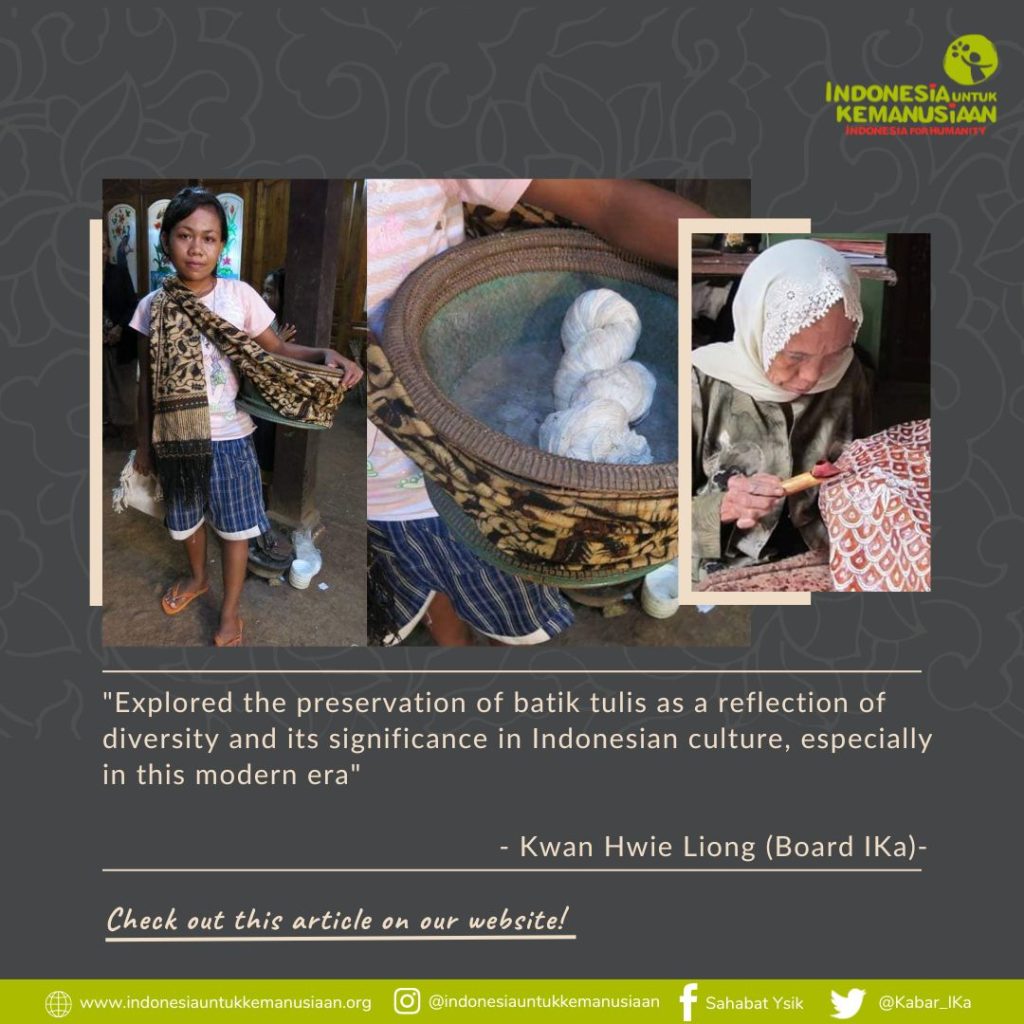
Ngulik Budaya, Exploring the Cultural Preservation of Batik Tulis and Its Artisans

Tulis as a Form of Diversity, Sustainability, and Local Wisdom,” a cultural discussion held last Friday (14/4). The discussion was designed by Humaira Sentosa, Prysafella Deviena, and Tariska Salsabila, three University of Indonesia students currently conducting practicum at IKa. Ngulik Budaya was held online via Zoom and featured Kwan Hwie Liong (William Kwan), the Director of the Institut Pluralisme Indonesia/Institute for Pluralism in Indonesia (IPI) and an observer of batik.

In recent years, there has been a renewed focus on preserving batik tulis as one of Indonesia’s cultural identities. “Ngulik Budaya” emerged as a response to the struggle of batik tulis to remain relevant today. This is because batik tulis now has to compete with fast fashion trends and the demands of the industry for faster and cheaper production methods. William Kwan explored the preservation of batik tulis as a reflection of diversity and its significance in Indonesian culture, especially in this modern era.

William explained that every region in Indonesia has a unique style of batik, reflecting local culture, history, and natural environment. The use of batik is not limited to clothing, as it is also used for various purposes such as decoration and religious rituals. Batik motifs can vary from simple geometric designs to complex narrative scenes, each with its own symbolism and meaning.

The welfare of batik craftsmen is closely linked to the preservation of batik as a cultural heritage. These craftsmen inherit the tradition of making batik designs from their ancestors, and their livelihoods depend on their ability to continue practicing this craft. The emergence of mass-produced textiles poses another challenge for batik craftsmen. Therefore, the sustainability of the batik craftsmen community is also a focus of this cultural discussion.

However, William revealed the reality that most batik makers only receive wages in the tens of thousands of rupiah each month. This is certainly not commensurate with the fact that batik makers are cultural heroes who play an important role in preserving Indonesia’s cultural heritage.

William saw that one reason for the low wages of batik makers is the lack of research to understand the demand and market interest where batik is developed. “Until now, the production of batik and wages at the local level have not been closely related to the larger market, whether in Indonesia or abroad. For example, in Sweden, what do people like, and what pattern are they interested in? If we can understand that, then our batik can have high value,” he said.

In addition, William noted that the low wages of batik artisans could have an impact on the interest of young people in becoming the next generation of batik artisans. Therefore, the government needs to make efforts to map out potential regions for batik’s markets and study the preferences and demands of the markets in those areas. From there, plans can be made to develop batik that can attract young people to get involved in the industry.

Nevertheless,  efforts to cultivate an interest in batik can also be initiated even if the government has not yet taken action. One way is to utilize the current trend of young people attending workshops, particularly in urban areas. Workshop organizers can hold classes on batik making. This way, young people not only satisfy their desire to try something new but also participate in cultural preservation. Eventually, when their love for batik has taken root, transforming that passion into a source of income will become more open. “The hope is that batik can become one of the sources of income for young people,” said William.

IKa, as a civil society resource organization, supports the sustainability of batik makers and preservation activists. This cultural discussion is also an invitation to donate through Pundi Budaya, a resource mobilization program by IKa dedicated to supporting artists, activists, and defenders of culture and diversity.

“Specifically at IKa, we have the Pundi Budaya program, so hopefully through proactive activities, we can encourage the preservation of batik and other Indonesian cultural heritage. Our hope is to develop an empowered community, including in the field of batik,” said William.

Batik-making is not only an art form; it is also a reflection of Indonesia’s cultural diversity. In addition to maintaining the sustainability of batik makers, preserving batik is also necessary to ensure that future generations can still witness the beauty of batik and celebrate Indonesia’s cultural diversity.
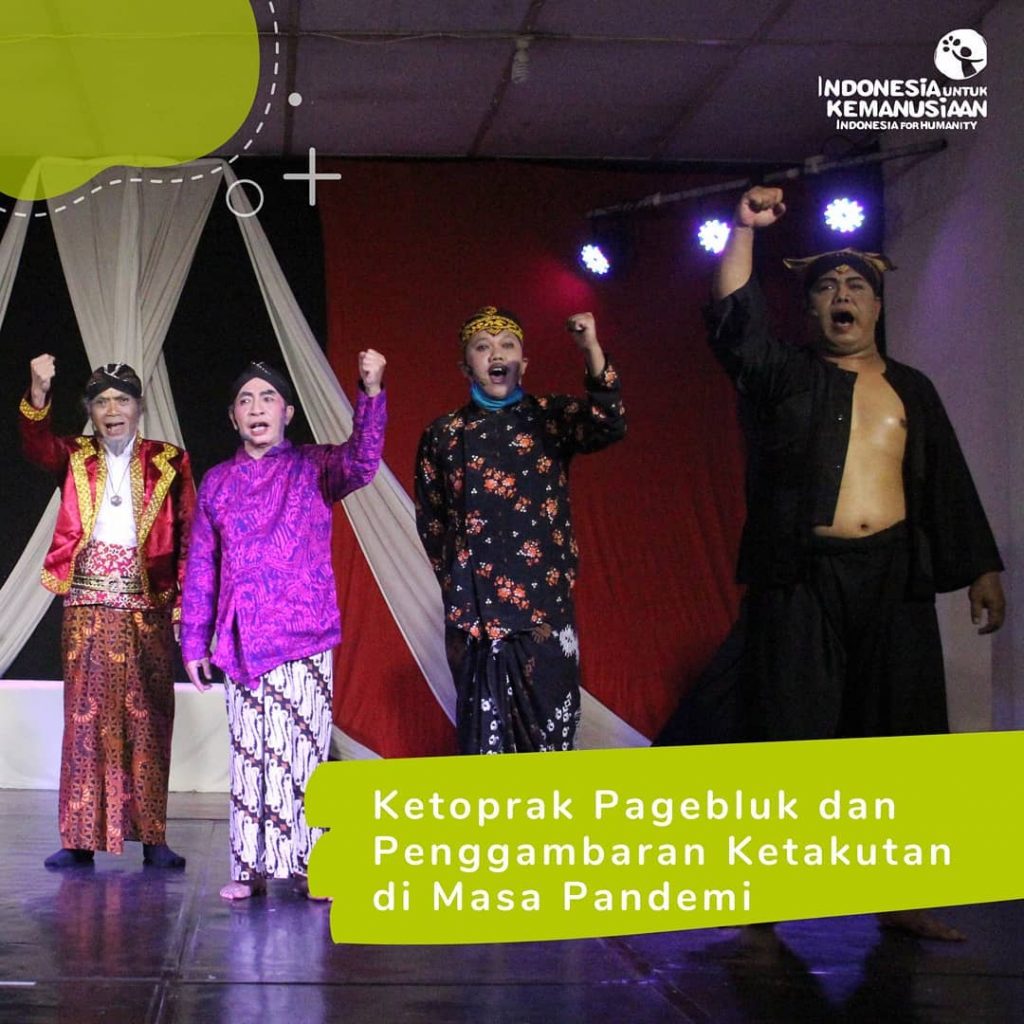
Ketoprak Pagebluk*: Representing Fear and the Pandemic

The Covid-19 pandemic is something that places fear into the hearts of the Indonesian people. The first case of this virus in Indonesia was discovered two months ago, and now there are more than 12 million people infected worldwide. This fear is similar to the fear that was experienced by the victims of the ’65 political tragedy and the 30 September Movement mass killings.

“In ’65 they were thrown into prison, on Buru Island, and now they are being ostracized by their families, their corpses are stigmatized because of a disease. So it’s the same, the ’65 tragedy and this corona pandemic,’ said Winarso, Coordinator of the Ketoprak Srawung Bersama (KSB) theater group – ketoprak is a traditional Javanese theatrical form.

Pagebluk, the title of the performance (meaning plague in Javanese), directed by ST Wiyono, evolved from an idea by Winarso. ST Wiyono is an artist and playwright that has devoted 32 years of his life to the Surakarta Cultural Center (Taman Budaya). His work always addresses three elements: education, culture and creation. A lot of ST Wiyono’s work, particularly from 1980-1990, was highly regarded at national level. His plays Dua Matahari (Two Suns), Ranggalawe (a Javanese historical figure) and Gendhuk Gotri (a Shadow Puppet character) all made it into the top three at the National Theater Festival.

Ketoprak Pagebluk involves both traditional and modern performers, the grandchildren of victims and other young people, mainly students from two of Surakarta’s universities. The performance is accompanied by musicians from Lumbini. Ketoprak Pagebluk’s performance was supported by Indonesia for Humanity (IKa) and the Peduli Program.

The Peduli Program is a program working on poverty eradication that adopts an inclusive development approach in order to ensure that marginal communities are able to participate in and reap the benefits of development. The Peduli Program works with and for marginalized communities all over Indonesia, to support their access to public services and economic opportunities.

Originally, the ketoprak troupe was going to perform an adaptation Mangir, a story by Pramoedya Ananta Toer, on 28 March 2020. However, Sekber ’65 (an organization representing victims of the 1965 humanitarian tragedy) in consultation with the artists, decided to put on a show that responds to the current situation instead. The decision was taken to put on a ketoprak performance aimed at educating the audience about the pandemic, and thus Pagebluk was written to be performed online so that it could be viewed by a wider audience, along with a discussion on the theme of Covid-19.

Pagebluk tells the story of Seloguminto District which has been struck by Covid-19. Initially, the District Head was unsure how to respond to the plague, but following discussion with two of his trusted advisers, he decided to introduce a lockdown of the District, which is an acronym of:

L:         Lungguh ayem ning omah (sitting in peace at home)

O:         Ora usah keluyuran (can’t leave the house if it’s not important)

C:         Cukup ngasohi (take lots of rest)

K:         Kumpul karo keluarga (gather and be happy with your family)

D:         Dipepe awake (bathe in the rays of the sun)

O:         Olahraga secukupe (exercise)

W:        Wisuh karo sabun (wash your hands with soap)

N:         Ngerungo seng akeh (don’t make a fuss)

This decision didn’t come out of the blue. Initially Adimas Senopati, one of the District elders, felt that the District Head had to issue a firm policy in order that Covid-19 be contained. He pushed for a policy that would see the arrest of any villagers that dared to leave their homes. He did not care about the rights of the villagers. However, thanks to discussion with one of the soldiers who felt guilty at having perpetrated acts of violence and mass killings 55 years previously, in the end the District Head issued a policy that focused on containing the virus but also honored human rights.

Cultural Approach to Addressing Human Rights

To this day, the discussion of gross human rights violations in Indonesia requires an approach that is deemed acceptable by society. Both traditional and contemporary art forms are used to discuss social issues, but their use in raising human rights issues remains limited. Artists and performers themselves also have different opinions. Winarso recounts that initially, many traditional and contemporary artists in Surakarta rejected the idea of portraying human rights violations.
 

After a lot of discussion and through a personal approach, a number of artists and performers agreed to raise the issue of gross human rights violations. In addition, some of the artists and performers met with the victims and their children and grandchildren so that they could get a complete picture of what the victims and their families experience. Following this process, a number of parties became involved in the production that was presented by KSB, including students and lecturers from two universities in Surakarta.

Ketoprak Pagebluk was well received by the broader public. This is because ketoprak is a traditional theatrical genre which is not only entertainment but also has the capacity of providing education to the public regarding Covid-19 and gross human rights violations were perpetrated in Indonesia. Moreover, the Mayor of Surakarta gave his appreciation of the production via a short WhatsApp message expressing his hope that Pagebluk might be performed in the Municipal Hall.

The Ketoprak Pagebluk production is an effective approach that can be further developed by other parties in order to provide public education regarding gross human rights violations in Indonesia. We all need to remember and learn from the past in order that these tragedies might not be repeated in the future.

“With the arts we can educate the public without being patronizing. The Arts are a very powerful medium that can be gladly received by the public,” said Winarso.

*Ketoprak is a traditional Javanese theatrical form; Pagebluk is a Javanese word for plague

Selalu dapatkan kabar terbaru dari kami!