Unveiling the philanthropic landscape: A reflective journey

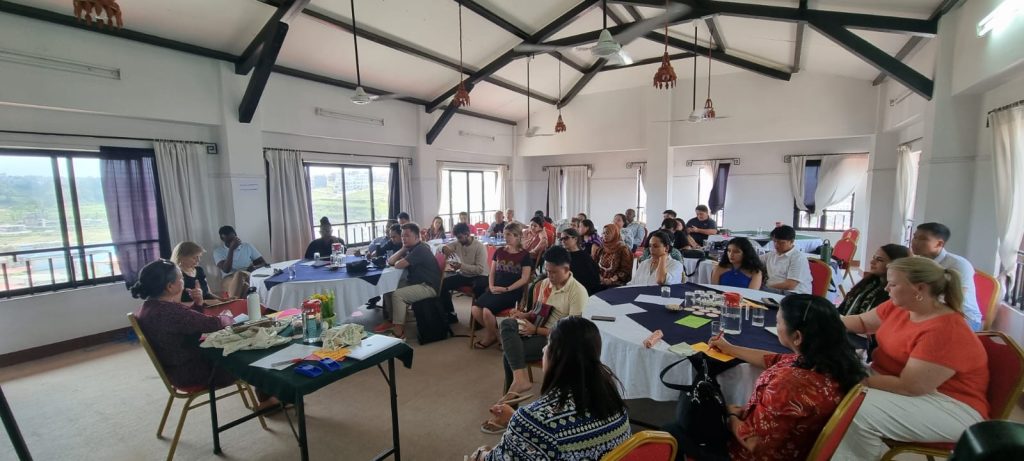
#ShiftThePower Peer-learning Event by the Global Fund for Community Foundations (GFCF), held at Tewa Center, Kathmandu, Nepal in May 2023, was attended by philanthropic actors from various countries.

The GFCF #ShiftThePower peer-learning event held at the Tewa Center in Kathmandu in May 2023 was a diverse assembly of philanthropic actors hailing from various corners of the world. Unbeknownst to me, as I stepped into this dynamic space, it ignited a profound odyssey of introspection and rigorous scrutiny of power dynamics within the realm of philanthropy. The event’s discussion and insights proved to be a thought-provoking experience, stimulating me to re-evaluate my preconceived notions regarding the significance of an organization such as mine – Indonesia untuk Kemanusiaan (IKa for short, and in English Indonesia for Humanity) – in our capacity as a civil society resource organization.

The event served as a revelation, shedding light on the frequently disregarded power dynamics that are deeply ingrained in intermediary organizations. It implored us to meticulously unravel the intricacies and conscientiously evaluate our influence on the communities we cater to. We found ourselves compelled to ponder whether our well-meaning endeavours inadvertently uphold a narrative that deprives local communities of their autonomy and resources. It became clear to me that we must relinquish this stigmatization and cultivate a milieu where communities are acknowledged as proactive agents of change and decision-makers in their own regard.

The discussions too underscored the pressing imperative to transcend conventional donor-recipient dynamics and to re-conceptualize partnerships as equitable collaborations. We have to cast off the lens of external presumptions and embrace a more nuanced approach. We ought not to impose prescriptive solutions, but rather be committed to active listening, adaptation, and support. The conversations underscored the significance of acknowledging that communities inherently possess their own knowledge, resources and capabilities. All too frequently, these invaluable assets go untapped, hindered by external perceptions that portray communities as being devoid of agency or resources. It is by deconstructing biases and power structures that we can pave a fresh path toward the genuine empowerment of communities.

Nurturing localization and ownership poses its fair share of challenges. It necessitates humility and a steadfast dedication to sustained involvement. However, the rewards are profound: a philanthropic landscape that is both equitable and sustainable, empowering communities to become the architects of their own development.

As participants from diverse backgrounds and philanthropic fields shared their experiences and insights, a shared comprehension materialized – that Southern civil society possesses the tremendous capacity to defy, shape and forge a fresh framework of authority and unity. However, in order to grasp this notion, we must transcend the limitations of conventional gathering spaces and authentically embody the ideals we strive to uphold. Merely engaging in discussions and formulating strategies falls short; we must behave like a movement in action.

To embody the essence of a movement, we must go beyond mere passive participation. In order to truly make a difference, we must exhibit a willingness to step outside our comfort zones, challenge the status quo, and rally others to join us in our pursuit of justice and equity.

As a citizen of the Global South, I believe that we bear a distinctive obligation to propel this movement onward. It is imperative that we tap into our collective power, utilizing the richness of our varied expertise and experiences to push for meaningful transformation. The change we strive for cannot be entrusted solely to external actors or institutions. Instead, we have to take responsibility for our destinies and emerge as agents of transformation in our own regard. It entails harnessing our networks, both online and offline, forging connections, exchanging resources and cultivating cooperation. It is important that we do not shy away from confronting deeply ingrained systems and structures that perpetuate both inequality and exploitation.

We shall draw inspiration from the historical currents that have shaped our world, from the battles for civil rights to the relentless struggles against colonialism and systemic oppression. These movements were propelled by everyday individuals who rejected the prevailing order and dared to imagine an alternative future.

Ultimately, the focus extends beyond IKa or any solitary institution. It encompasses a collaborative endeavour that surpasses geographical boundaries and empowers the communities we are dedicated to supporting.

None of us simply exists as passive participants in the grand scheme of things; for we are the catalysts of change and the architects of our own progress.

This article is a reflective piece from the GFCF Peer-learning Event on the #ShiftThePower movement. It is also published in English and can be accessed on the GFCF website.
Transgender Community Fajar Sikka: The Bright Spot at The Darkest Moment of Lembata and Adonara Flood

Various forms of attention, as well as solidarity actions, were taken to respond to the Lembata and Adonara Flood last April. One that took part in these solidarity actions was Bunda Mayora Victoria along with Fajar Sikka, the organization of the local trans women community that was founded by Bunda in 2018 in Maumere, Sikka. Bunda Mayora or also known as the first trans women public officer in Indonesia, is a Chief of Badan Permusyawaratan Desa (BPD) in the Habi Village, Kangae District, Sikka Regency, Nusa Tenggara Timur (NTT).

Bunda, along with her friends, Mrs. Yolanda, Mrs. Paulina, from Fajar Sikka and Mrs. Venti as well as Mrs. Intan and Mrs. Bening from Lembata, and IKatan WAria Larantuka (IKWAL) were at the forefront of this solidarity action, distributing aids such as clean water, groceries, medicines, masks, clothes for adult and children, underwear and women necessities. From the first three to four days, the end of April to this July, Bunda and her peers were hand in hand in assisting Adonara and Lembata residents to get back on their feet again.

Two months after the flood, Adonara, and Lembata are entering the reconstruction phase. Assessment and documentation of the damaged school buildings, infrastructure as well as housing are already taking place. In the meantime, many of the local residents moved from the emergency posts to the family farms. The construction of standard/emergency housing of 2 rooms, using bamboo and foundation as the materials, has also gained government support.

The careful and special attention was given to the Ile Ape residents that saw their villages erased before them. Healing therapy for the children from 2 years old, 5 graders, and the middle school students was performed by Bunda and her friends. Most of the children now fear the water and the wind. Stories of water and wind that were brought by Bunda and her friends, reminded the children how water and wind could function and benefits our lives. Through fun games to create cool wind, Bunda reached and touched these children. Moreover, character-building also became another focus of this therapy session. To this day, the activity has engaged 40 to 50 children.

Not only that, but Fajar Sikka’s other mission is also to help the economy getting back on track. Fajar Sikka distributed assistance to the weaving communities that taken the form of business startup capitals, for example, by providing balls of yarns and cotton to create the Ikat, could earn them 400 thousand rupiahs. During the visit to emergency posts, Bunda also organized socialization regarding Covid-19 Health Protocol that is needed to be adhered to then masks distribution to stop the chain of Covid-19.

The assistance from Bunda and her friends were welcomed with open hands by the villagers of Amakaka, Ile Ape, and Oyong Barang. Bunda has distributed assistance to 60 to 90 households in each village. Through arisan (a form of rotating savings and credit) as well as the disaster stories that they spread, Bunda and her friends had fundraised the money and received assistance that is ready to be distributed to the public. 

Yet, amidst assistance distribution, Bunda was also facing several challenges, the long distance travel from Maumere to Sikka that needs 4 hours journey, so Bunda have to leave very early in the morning, at 2 a.m and sometimes at 4 a.m to get to Sikka. Fortunately, NTT is rather safe, so there is less need to worry about traveling earlier in the morning. Another challenge is social jealousy because of the discrepancies in assistance distribution to fit each need and capacity While there was grief, was there also an entertaining story from the field. Many thought the trans women are a vulnerable community that is feminine, but, when Bunda visited the soup kitchen in the shelters and faced with urgent matters, causing Bunda to have carried the sack of rice by herself. Bunda quickly carried the sack of rice that made this a funny story to Bunda and the other refugees.

The solidarity action that was taken by Bunda to respond to the Lembata and Adonara floods, was not the first. Instead, Bunda has been active in social work long before Fajar Sikka was founded in 2018. Social assistance was among the social activities that Fajar Sikka organized. The other activity is advocacy that target the minority groups including transwomen, disabled communities, elders, and widowers as the main target population of the social activities in Fajar Sikka. The expectation is that through advocacy, minority groups could gain their identity cards (KTP), the social assistance (BST), Indonesia Health Card (KIS), Sikka Health Card as well as the other basic rights. Bunda also distributed another form of assistance such as the business startup capitals for the trans women to create and drive trans women communities’ active participation in the wheel of ecgetting back on track. Fajar Sikka distributed assistance to the weaving communities that taken form of business startup capitals, for example, by providing balls of yarns and cottons to create the Ikat, could earned them 400 thousand rupiah. During the visit to emergency posts, Bunda also organized socialization regarding Covid-19 Health Protocol that is needed to be adhered to then masks distribution to stop the chain of Covid-19.

The assistance from Bunda and her friends were welcomed with open hands by the villagers of Amakaka, Ile Ape and Oyong Barang. Bunda has distributed assistance to 60 to 90 households in each village. Through arisan (a form of rotating savings and credit) as well as the disaster stories that they spread, Bunda and her friends had fundraised the money and received assistance that is ready to be distributed to the public.  

Yet, amidst assistance distribution, Bunda was also facing several challenges, the long distant travel from Maumere to Sikka that needs 4 hours journey, so Bunda have to leave very early in the morning, at 2 a.m and sometimes at 4 a.m to get to Sikka. Fortunately, NTT is rather safe, so there is less need to worry in traveling earlier in the morning. Another challenge is social jealousy because of the discrepancies in assistance distribution to fit each need and capacities. While there was grief, was there also an entertaining story from the field. Many thought the trans women is a vulnerable community that is feminine, but, when Bunda visited the soup kitchen in the shelters and faced with urgent matters, causing Bunda to have carried the sack of rice by herself. Bunda quickly carried the sack of rice that made this a funny story to Bunda and the other refugees.

The solidarity action that was taken by Bunda to respond the Lembata and Adonara floods, was not the first. Instead, Bunda has been active in social work long before Fajar Sikka was founded in 2018. The social assistance was among the social activities that Fajar Sikka organized. The other activity is advocacy that target the minority groups including transwomen, disabled communities, elders and widowers as the main target population of the social activities in Fajar Sikka. The expectation is that through advocacy, minority groups could gain their identity cards (KTP), the social assistance (BST), Indonesia Health Card (KIS), Sikka Health Card as well as the other basic rights. Bunda also distributed another form of assistance such as the business startup capitals for the trans women to create and drive trans women communities’ active participation in the wheel of economic of Nusa Tenggara Timur. 

The working mechanism of Fajar Sikka is really a reflection of Fajar Sikka’s founding stories that grew out of concern during Bunda Mayora’s journey as a trans woman. Bunda saw many acts of violence against trans women when she was in Yogyakarta, even when she was doing a street performance to provide for herself. The concern after seeing herself and her peers not having identity cards, unable to gain basic rights because of it, and unable to express themselves. For Bunda Mayora, kindness is necessary for erasing the stigma and in fighting for inclusiveness, “Experience of kindness has been in my life ever since I was young until I am grown. I have been in a life where everything is abundant. Then, when I become a trans woman, my life becomes very modest, there are many stigmas, discrimination, and many things that feel unfit. Then, I thought to myself, until how long do I want to hate the situation. This is life. (As long) as our lives are, let’s do good. When we departed, we don’t bring anything. Everyone deserves kindness from the universe, from God. I too have been healthy because of acceptance.”

Started from inclusiveness, Bunda Mayora with her Fajar Sikka peers have been actively involved in society through the Integrated Health Centre cadre, working in the soup kitchen, and supporting the KLB.

I reached out to Catholic friends, Moslem trans women, Moslem and Christian widowers. This is tolerance, even with vulnerability, we are not limiting ourselves, we do good deeds, and the resentment falls in, the government accepts us. Since 2018, to this day, no matter what the gender concept was that only men and women, coming from the out of question families, that people thought (only) know of cooking, grooming, women with feral works, but now, many people support us, co-existing with us, added Bunda. And eventually, Bunda Mayora, Fajar Sikka is not only bringing the lights in the Lembata and Adonara disaster. But also becoming the lights, in the darkness that was facing the minority groups especially the trans women communities in Sikka.

Selalu dapatkan kabar terbaru dari kami!