In Memory of the Unspoken Histories

Eid al-Fitr, known in Indonesia as Idul Fitri, is one of the most important religious holidays in the Muslim world. It marks the end of Ramadan, a holy month of fasting, prayer, and reflection. Eid is a time for family, celebration, and sharing, especially with those in need. It offers a moment to express compassion, solidarity, and humanity.

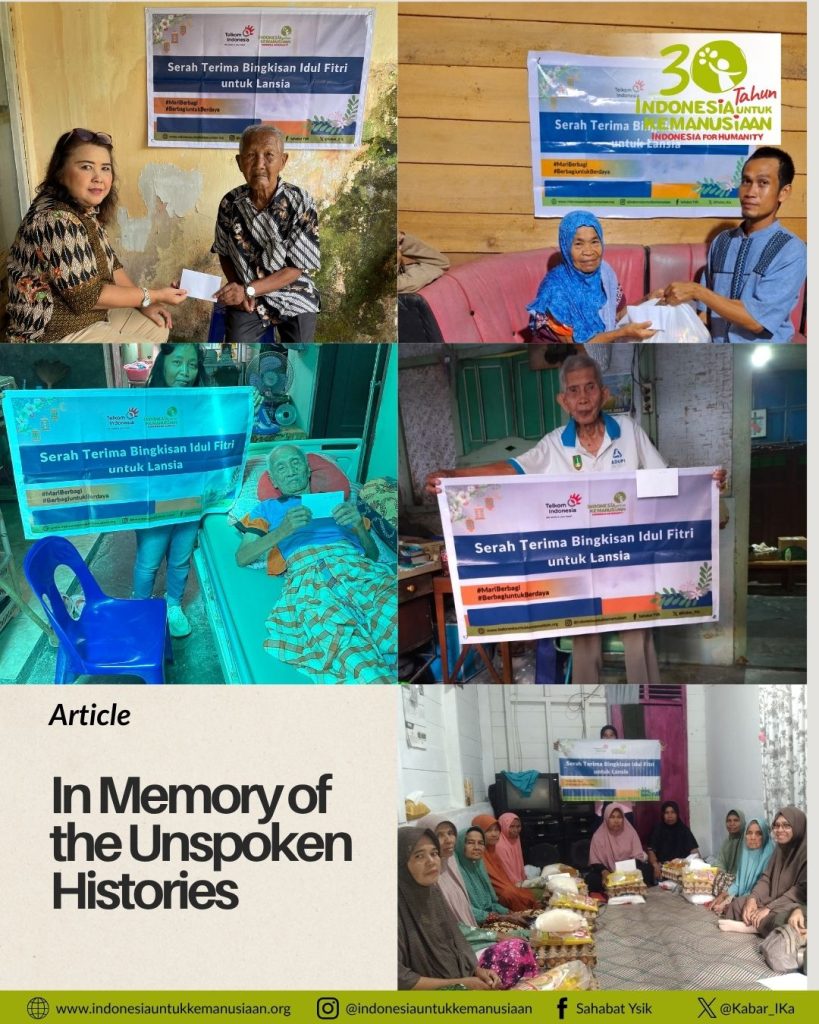
In the spirit of Eid, Indonesia for Humanity (IKa), through its Pundi Insani platform, a fundraising initiative for the recovery and empowerment of victims of human rights violations, carried out the “Eid Gift for the Elderly” program. This program is a form of respect and support for elderly individuals, particularly those who are survivors or family members of survivors of past human rights violations. Throughout their lives, many have endured stigma, discrimination, and social exclusion.

These Eid gifts were distributed through IKa’s grassroots community networks across four regions: Nanggroe Aceh Darussalam (NAD), Sumatra, Java, and Sulawesi. These communities have consistently accompanied and supported elderly survivors in their respective areas.

With a spirit of volunteerism and deep compassion, community members visited each elder door to door, even venturing into remote and hard-to-reach areas, to ensure the gifts were received by those most in need. This distribution method demonstrates not only the communities’ commitment to humanitarian values but also ensures that no elderly survivor is forgotten.

Java: “Diuwongke” — Feeling Seen and Valued

In Java, IKa collaborated with a local survivor organization that has long advocated for reconciliation as a means to address serious human rights violations of the past. Many of the elderly survivors in this region live alone and rely on others for support. For them, the Eid gift is more than material assistance—it is a symbol of recognition and dignity. The Javanese word “diuwongke”, meaning “to be treated as a person,” captures this feeling.

Mrs. MG (82), who lives alone in a small house at the edge of a yard, beamed with joy as she received her gift. She shared her hope of using the money to buy food and pay for transportation to the community health center and her church.

Mr. SK (79), who cares for his wife with mental health challenges while farming modestly, expressed heartfelt gratitude:

“Thank you very much, this help eases our daily needs. But more than the money, this support makes me feel ‘diuwongke’—valued and acknowledged.”

His words remind us of how fragile, yet deeply thankful, their lives remain.

Nanggroe Aceh Darussalam (NAD): “Overcoming Obstacles, Finding Hope”

In Aceh, IKa partnered with a local organization focused on empowering women and children and advocating for human rights. Distributing the Eid gifts here was no easy task—volunteers braved pothole-ridden roads, landslides, and relentless heavy rain. Yet their spirit never wavered. They traveled across difficult terrain to deliver the gifts to elders who waited with hope and anticipation.

The emotional responses and sincere words of thanks from the recipients revealed the deep meaning behind this act of care. They no longer felt forgotten—someone still remembers them, still cares, even from afar.

Sulawesi: Mrs. CT and a Symbol of Hope

In Kendari, IKa collaborated with Jaringan Bersama Nanga-Nanga (JBN), one of IKa’s grassroots community networks actively assisting vulnerable groups. Here, the story of Ibu Catem vividly illustrates the harsh reality of life as a survivor of human rights violations.

Living in a modest home and having never received any aid before, Ibu Catem was deeply moved and almost in disbelief when she received the Eid package. To her, this was more than just daily necessities—it was a symbol that she is still remembered, that someone still cares, and that her life, though quiet and difficult, has not been completely overlooked.

Sumatra: An Unfading Personal Commitment

In Sumatra, IKa partnered with Mr. YF, an individual volunteer and the child of a human rights violation survivor. With personal dedication, he delivered the gifts to elderly survivors across multiple locations. Mr. YF is not only a volunteer but also part of the survivor community. He understands deeply the pain and historical burden still carried by these elders. His commitment stands as a powerful testament to intergenerational solidarity and remembrance.

The stories and reflections gathered from these communities highlight the lives of elderly survivors who are rarely seen by the public. These are not just elders, they are living witnesses to a dark chapter in history that continues to leave emotional and social scars.

Through these simple Eid gifts, Indonesia for Humanity (IKa) and its network offer more than material support. They send a powerful message: You are not alone. You are still seen. Compassion and solidarity live on, even among those who did not experience your suffering firsthand.
To all our supporters, especially our international donors, we extend our deepest gratitude. Your contributions keep the light of humanity burning and give hope to those who have carried silent burdens for far too long. Thank you for walking with us.

Article Christmas: Care and Hope For Si Mbah

Christmas is a time to share kindness and compassion in meaningful ways. From Indonesia untuk Kemanusiaan (IKa), we extend our deepest gratitude to our generous donors for their unwavering support of Si Mbah Penyintas ’65—the elderly survivors of the 1965 tragedy in Indonesia. Through their contributions, we were able to distribute 97 care packages and financial assistance to Si Mbah in Banyumas, Southeast Sulawesi, North Sulawesi, and East Nusa Tenggara.

Many of Si Mbah Penyintas ’65, now in their twilight years, continue to bear the weight of state injustice that marked their youth. In Banyumas, they have formed a close-knit community called “Paguyuban 10 November” (The November 10th Gathering), where they meet monthly, taking turns hosting at one another’s homes or in coffee shops owned by their mentors. These gatherings serve as a therapeutic space, where they sing, dance, and share their stories—finding solace and strength in each other’s presence. To help meet their daily needs, the community also established a Koperasi Simpan-Pinjam (Savings and Loan Cooperative).

Our visit to Si Mbah during the Christmas season was deeply emotional. As we handed them the Christmas gifts, many recalled their painful past as if it had happened yesterday. Some spoke of the stigma that followed them for decades—the way their families were vilified, exiled from their communities, and denied access to education. Overwhelmed with emotion, some broke down in tears, unable to finish their stories.

One of the women, a Si Mbah who remains unmarried to this day, shared how the labels of the past robbed her of the life she once envisioned. Her former fiancé, like many others, refused to marry her, saying:

“You’re a communist, a criminal, from a dishonorable family. I want nothing to do with you or your kin.”

Those words, etched into her memory, became a wound too deep to heal—a trauma that led her to a life of solitude.

Yet, amidst the sorrow, there were also moments of joy and gratitude. Si Mbah Sanjan, one of the survivors, expressed his astonishment and appreciation upon receiving the Christmas donation:

“Thank you, Indonesia untuk Kemanusiaan (IKa), and to all the donors who care for me. I never imagined that people would not only donate but also visit. Usually, the only ones who come to see us are the Witness and Victim Protection Agency (LPSK). IKa, may your mission continue to thrive. It amazes me that the ones who have helped us are ordinary workers—people earning minimum wage—while the government, despite its wealth, has done so little.”

As we celebrate the spirit of giving, IKa mourns the passing of one of the Si Mbah who received a Christmas gift, just weeks later, on January 21st. During our visit, he repeatedly expressed his shock and gratitude that we had come to see him. His words of thanks linger in our hearts, a solemn reminder of how much these small acts of care mean to those who have been forgotten for so long.

We know that no amount of aid can fully heal the wounds of Si Mbah’s past. But our commitment to humanity and justice will remain steadfast, ensuring that they continue to receive support, dignity, and recognition. With the continued generosity of donors, support from the GlobalGiving platform, and the collaboration of other partners, we will persist in standing by Si Mbah Penyintas ’65.

As we reflect on this season of giving, let us carry forward the spirit of solidarity—extending our care not just at Christmas but across all moments of shared faith and humanity. May we never allow indifference to dim the light of Si Mbah’s resilience or let their struggle be forgotten.

Ibu Betet: A Journey of Strength and Solidarity

Ibu  (a polite call for women)  Sumiati, known as Bu Betet, is a survivor of the grave human rights violations that took place during the 1965/1966 tragedy in Indonesia. She currently resides in Klaten, Central Java. On August 9, 2024, a team from Indonesia for Humanity (IKa), consisting of three members, visited her home to offer support after a devastating fire in July 2024.

A visit by the Indonesia for Humanity team to Klaten was a meaningful act of solidarity, reinforcing the bond between IKa and the survivors of historical injustices. For Ibu Betet, our presence was a source of encouragement, helping her stay resilient in the face of hardship. The collective support, including from IKa and Sekber ’65 (a community that supports survivors of the 1965 tragedy), has given her confidence and renewed strength.

During our morning visit, we sat with Ibu Betet outside her burnt-down house as she recounted stories of her life. The fire, which occurred while she was at church, left only the walls and a few chairs intact. Despite the loss, her spirit remained unbroken. She even sang to express her joy at being cared for, inviting us, her friends from IKa, to join in.

As the songs faded, Ibu Betet shared memories of her teenage years, recalling her time in prison and her efforts to provide food and money to political prisoners (Tapol) from her village, including her brother. She spoke with pride, not only about her fight for justice but also about how she has empowered others throughout her life.

Ibu Betet also reflected on her days as a bridal makeup artist. She often offered her services at discounted rates or even free of charge when the bride and groom couldn’t afford to pay. More recently, her home had become a haven for students conducting community service projects (KKN) in her village.

Amid the tragedy, a remarkable sense of solidarity emerged. Neighbors and relatives quickly came to offer sympathy and support. The local community rallied together, helping to extinguish the fire alongside the firefighters.

The day after the fire, the Regional Disaster Management Agency (BPBD) arrived with assistance, and the rebuilding process began. Ari, one of her neighbors who works as a contractor, volunteered to cover the construction costs. A community team was formed to oversee the reconstruction, manage the public kitchen, and coordinate incoming aid.

Her unshakable spirit continues to amaze all who meet her. Volunteers and donors who came to comfort her found themselves receiving wisdom and inspiration instead.

Ibu Betet’s life is a testament to the power of kindness and solidarity. Despite the hardships she has faced, her generous heart and unwavering dedication to helping others have made her a beacon of hope in her community. The overwhelming public support she has received in the wake of the fire is a reflection of the Indonesian proverb, kita menerima apa yang kita tebar—”we reap what we sow.” Through her lifelong acts of kindness, Ibu Betet has sown goodness into the world, and in return, she has drawn goodness back to her.

Her resilience and the solidarity of those around her stand as powerful reminders that in the face of adversity, the human spirit is lifted when we support each other. Through this mutual care, we see the true beauty of community: when we give kindness, we invite kindness back into our lives.

Unveiling the philanthropic landscape: A reflective journey

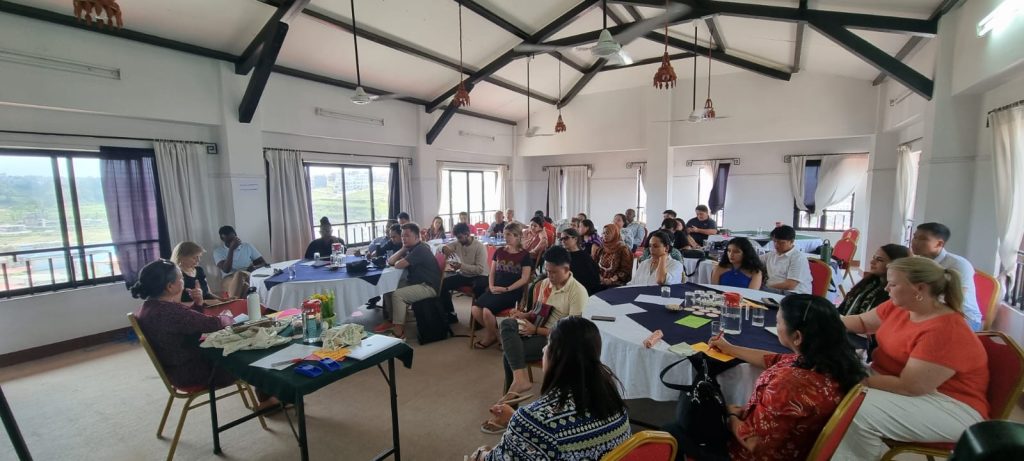
#ShiftThePower Peer-learning Event by the Global Fund for Community Foundations (GFCF), held at Tewa Center, Kathmandu, Nepal in May 2023, was attended by philanthropic actors from various countries.

The GFCF #ShiftThePower peer-learning event held at the Tewa Center in Kathmandu in May 2023 was a diverse assembly of philanthropic actors hailing from various corners of the world. Unbeknownst to me, as I stepped into this dynamic space, it ignited a profound odyssey of introspection and rigorous scrutiny of power dynamics within the realm of philanthropy. The event’s discussion and insights proved to be a thought-provoking experience, stimulating me to re-evaluate my preconceived notions regarding the significance of an organization such as mine – Indonesia untuk Kemanusiaan (IKa for short, and in English Indonesia for Humanity) – in our capacity as a civil society resource organization.

The event served as a revelation, shedding light on the frequently disregarded power dynamics that are deeply ingrained in intermediary organizations. It implored us to meticulously unravel the intricacies and conscientiously evaluate our influence on the communities we cater to. We found ourselves compelled to ponder whether our well-meaning endeavours inadvertently uphold a narrative that deprives local communities of their autonomy and resources. It became clear to me that we must relinquish this stigmatization and cultivate a milieu where communities are acknowledged as proactive agents of change and decision-makers in their own regard.

The discussions too underscored the pressing imperative to transcend conventional donor-recipient dynamics and to re-conceptualize partnerships as equitable collaborations. We have to cast off the lens of external presumptions and embrace a more nuanced approach. We ought not to impose prescriptive solutions, but rather be committed to active listening, adaptation, and support. The conversations underscored the significance of acknowledging that communities inherently possess their own knowledge, resources and capabilities. All too frequently, these invaluable assets go untapped, hindered by external perceptions that portray communities as being devoid of agency or resources. It is by deconstructing biases and power structures that we can pave a fresh path toward the genuine empowerment of communities.

Nurturing localization and ownership poses its fair share of challenges. It necessitates humility and a steadfast dedication to sustained involvement. However, the rewards are profound: a philanthropic landscape that is both equitable and sustainable, empowering communities to become the architects of their own development.

As participants from diverse backgrounds and philanthropic fields shared their experiences and insights, a shared comprehension materialized – that Southern civil society possesses the tremendous capacity to defy, shape and forge a fresh framework of authority and unity. However, in order to grasp this notion, we must transcend the limitations of conventional gathering spaces and authentically embody the ideals we strive to uphold. Merely engaging in discussions and formulating strategies falls short; we must behave like a movement in action.

To embody the essence of a movement, we must go beyond mere passive participation. In order to truly make a difference, we must exhibit a willingness to step outside our comfort zones, challenge the status quo, and rally others to join us in our pursuit of justice and equity.

As a citizen of the Global South, I believe that we bear a distinctive obligation to propel this movement onward. It is imperative that we tap into our collective power, utilizing the richness of our varied expertise and experiences to push for meaningful transformation. The change we strive for cannot be entrusted solely to external actors or institutions. Instead, we have to take responsibility for our destinies and emerge as agents of transformation in our own regard. It entails harnessing our networks, both online and offline, forging connections, exchanging resources and cultivating cooperation. It is important that we do not shy away from confronting deeply ingrained systems and structures that perpetuate both inequality and exploitation.

We shall draw inspiration from the historical currents that have shaped our world, from the battles for civil rights to the relentless struggles against colonialism and systemic oppression. These movements were propelled by everyday individuals who rejected the prevailing order and dared to imagine an alternative future.

Ultimately, the focus extends beyond IKa or any solitary institution. It encompasses a collaborative endeavour that surpasses geographical boundaries and empowers the communities we are dedicated to supporting.

None of us simply exists as passive participants in the grand scheme of things; for we are the catalysts of change and the architects of our own progress.

This article is a reflective piece from the GFCF Peer-learning Event on the #ShiftThePower movement. It is also published in English and can be accessed on the GFCF website.

Selalu dapatkan kabar terbaru dari kami!