In Memory of the Unspoken Histories

Eid al-Fitr, known in Indonesia as Idul Fitri, is one of the most important religious holidays in the Muslim world. It marks the end of Ramadan, a holy month of fasting, prayer, and reflection. Eid is a time for family, celebration, and sharing, especially with those in need. It offers a moment to express compassion, solidarity, and humanity.

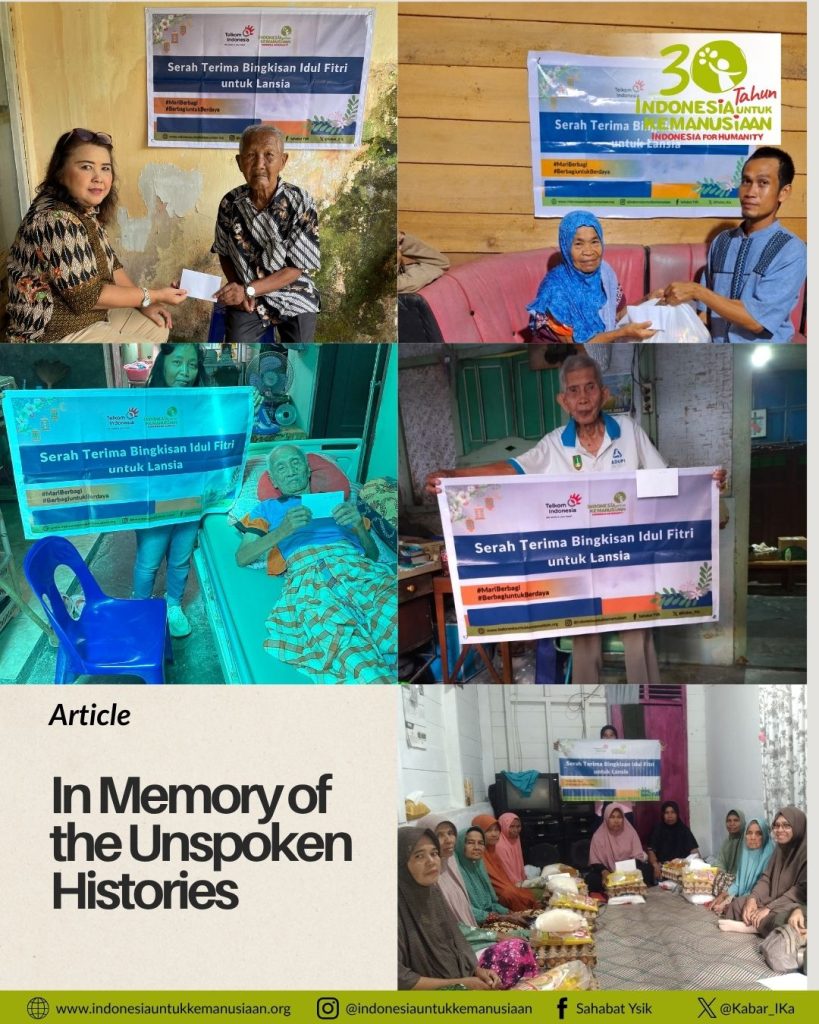
In the spirit of Eid, Indonesia for Humanity (IKa), through its Pundi Insani platform, a fundraising initiative for the recovery and empowerment of victims of human rights violations, carried out the “Eid Gift for the Elderly” program. This program is a form of respect and support for elderly individuals, particularly those who are survivors or family members of survivors of past human rights violations. Throughout their lives, many have endured stigma, discrimination, and social exclusion.

These Eid gifts were distributed through IKa’s grassroots community networks across four regions: Nanggroe Aceh Darussalam (NAD), Sumatra, Java, and Sulawesi. These communities have consistently accompanied and supported elderly survivors in their respective areas.

With a spirit of volunteerism and deep compassion, community members visited each elder door to door, even venturing into remote and hard-to-reach areas, to ensure the gifts were received by those most in need. This distribution method demonstrates not only the communities’ commitment to humanitarian values but also ensures that no elderly survivor is forgotten.

Java: “Diuwongke” — Feeling Seen and Valued

In Java, IKa collaborated with a local survivor organization that has long advocated for reconciliation as a means to address serious human rights violations of the past. Many of the elderly survivors in this region live alone and rely on others for support. For them, the Eid gift is more than material assistance—it is a symbol of recognition and dignity. The Javanese word “diuwongke”, meaning “to be treated as a person,” captures this feeling.

Mrs. MG (82), who lives alone in a small house at the edge of a yard, beamed with joy as she received her gift. She shared her hope of using the money to buy food and pay for transportation to the community health center and her church.

Mr. SK (79), who cares for his wife with mental health challenges while farming modestly, expressed heartfelt gratitude:

“Thank you very much, this help eases our daily needs. But more than the money, this support makes me feel ‘diuwongke’—valued and acknowledged.”

His words remind us of how fragile, yet deeply thankful, their lives remain.

Nanggroe Aceh Darussalam (NAD): “Overcoming Obstacles, Finding Hope”

In Aceh, IKa partnered with a local organization focused on empowering women and children and advocating for human rights. Distributing the Eid gifts here was no easy task—volunteers braved pothole-ridden roads, landslides, and relentless heavy rain. Yet their spirit never wavered. They traveled across difficult terrain to deliver the gifts to elders who waited with hope and anticipation.

The emotional responses and sincere words of thanks from the recipients revealed the deep meaning behind this act of care. They no longer felt forgotten—someone still remembers them, still cares, even from afar.

Sulawesi: Mrs. CT and a Symbol of Hope

In Kendari, IKa collaborated with Jaringan Bersama Nanga-Nanga (JBN), one of IKa’s grassroots community networks actively assisting vulnerable groups. Here, the story of Ibu Catem vividly illustrates the harsh reality of life as a survivor of human rights violations.

Living in a modest home and having never received any aid before, Ibu Catem was deeply moved and almost in disbelief when she received the Eid package. To her, this was more than just daily necessities—it was a symbol that she is still remembered, that someone still cares, and that her life, though quiet and difficult, has not been completely overlooked.

Sumatra: An Unfading Personal Commitment

In Sumatra, IKa partnered with Mr. YF, an individual volunteer and the child of a human rights violation survivor. With personal dedication, he delivered the gifts to elderly survivors across multiple locations. Mr. YF is not only a volunteer but also part of the survivor community. He understands deeply the pain and historical burden still carried by these elders. His commitment stands as a powerful testament to intergenerational solidarity and remembrance.

The stories and reflections gathered from these communities highlight the lives of elderly survivors who are rarely seen by the public. These are not just elders, they are living witnesses to a dark chapter in history that continues to leave emotional and social scars.

Through these simple Eid gifts, Indonesia for Humanity (IKa) and its network offer more than material support. They send a powerful message: You are not alone. You are still seen. Compassion and solidarity live on, even among those who did not experience your suffering firsthand.
To all our supporters, especially our international donors, we extend our deepest gratitude. Your contributions keep the light of humanity burning and give hope to those who have carried silent burdens for far too long. Thank you for walking with us.

Article Christmas: Care and Hope For Si Mbah

Christmas is a time to share kindness and compassion in meaningful ways. From Indonesia untuk Kemanusiaan (IKa), we extend our deepest gratitude to our generous donors for their unwavering support of Si Mbah Penyintas ’65—the elderly survivors of the 1965 tragedy in Indonesia. Through their contributions, we were able to distribute 97 care packages and financial assistance to Si Mbah in Banyumas, Southeast Sulawesi, North Sulawesi, and East Nusa Tenggara.

Many of Si Mbah Penyintas ’65, now in their twilight years, continue to bear the weight of state injustice that marked their youth. In Banyumas, they have formed a close-knit community called “Paguyuban 10 November” (The November 10th Gathering), where they meet monthly, taking turns hosting at one another’s homes or in coffee shops owned by their mentors. These gatherings serve as a therapeutic space, where they sing, dance, and share their stories—finding solace and strength in each other’s presence. To help meet their daily needs, the community also established a Koperasi Simpan-Pinjam (Savings and Loan Cooperative).

Our visit to Si Mbah during the Christmas season was deeply emotional. As we handed them the Christmas gifts, many recalled their painful past as if it had happened yesterday. Some spoke of the stigma that followed them for decades—the way their families were vilified, exiled from their communities, and denied access to education. Overwhelmed with emotion, some broke down in tears, unable to finish their stories.

One of the women, a Si Mbah who remains unmarried to this day, shared how the labels of the past robbed her of the life she once envisioned. Her former fiancé, like many others, refused to marry her, saying:

“You’re a communist, a criminal, from a dishonorable family. I want nothing to do with you or your kin.”

Those words, etched into her memory, became a wound too deep to heal—a trauma that led her to a life of solitude.

Yet, amidst the sorrow, there were also moments of joy and gratitude. Si Mbah Sanjan, one of the survivors, expressed his astonishment and appreciation upon receiving the Christmas donation:

“Thank you, Indonesia untuk Kemanusiaan (IKa), and to all the donors who care for me. I never imagined that people would not only donate but also visit. Usually, the only ones who come to see us are the Witness and Victim Protection Agency (LPSK). IKa, may your mission continue to thrive. It amazes me that the ones who have helped us are ordinary workers—people earning minimum wage—while the government, despite its wealth, has done so little.”

As we celebrate the spirit of giving, IKa mourns the passing of one of the Si Mbah who received a Christmas gift, just weeks later, on January 21st. During our visit, he repeatedly expressed his shock and gratitude that we had come to see him. His words of thanks linger in our hearts, a solemn reminder of how much these small acts of care mean to those who have been forgotten for so long.

We know that no amount of aid can fully heal the wounds of Si Mbah’s past. But our commitment to humanity and justice will remain steadfast, ensuring that they continue to receive support, dignity, and recognition. With the continued generosity of donors, support from the GlobalGiving platform, and the collaboration of other partners, we will persist in standing by Si Mbah Penyintas ’65.

As we reflect on this season of giving, let us carry forward the spirit of solidarity—extending our care not just at Christmas but across all moments of shared faith and humanity. May we never allow indifference to dim the light of Si Mbah’s resilience or let their struggle be forgotten.

Ibu Betet: A Journey of Strength and Solidarity

Ibu  (a polite call for women)  Sumiati, known as Bu Betet, is a survivor of the grave human rights violations that took place during the 1965/1966 tragedy in Indonesia. She currently resides in Klaten, Central Java. On August 9, 2024, a team from Indonesia for Humanity (IKa), consisting of three members, visited her home to offer support after a devastating fire in July 2024.

A visit by the Indonesia for Humanity team to Klaten was a meaningful act of solidarity, reinforcing the bond between IKa and the survivors of historical injustices. For Ibu Betet, our presence was a source of encouragement, helping her stay resilient in the face of hardship. The collective support, including from IKa and Sekber ’65 (a community that supports survivors of the 1965 tragedy), has given her confidence and renewed strength.

During our morning visit, we sat with Ibu Betet outside her burnt-down house as she recounted stories of her life. The fire, which occurred while she was at church, left only the walls and a few chairs intact. Despite the loss, her spirit remained unbroken. She even sang to express her joy at being cared for, inviting us, her friends from IKa, to join in.

As the songs faded, Ibu Betet shared memories of her teenage years, recalling her time in prison and her efforts to provide food and money to political prisoners (Tapol) from her village, including her brother. She spoke with pride, not only about her fight for justice but also about how she has empowered others throughout her life.

Ibu Betet also reflected on her days as a bridal makeup artist. She often offered her services at discounted rates or even free of charge when the bride and groom couldn’t afford to pay. More recently, her home had become a haven for students conducting community service projects (KKN) in her village.

Amid the tragedy, a remarkable sense of solidarity emerged. Neighbors and relatives quickly came to offer sympathy and support. The local community rallied together, helping to extinguish the fire alongside the firefighters.

The day after the fire, the Regional Disaster Management Agency (BPBD) arrived with assistance, and the rebuilding process began. Ari, one of her neighbors who works as a contractor, volunteered to cover the construction costs. A community team was formed to oversee the reconstruction, manage the public kitchen, and coordinate incoming aid.

Her unshakable spirit continues to amaze all who meet her. Volunteers and donors who came to comfort her found themselves receiving wisdom and inspiration instead.

Ibu Betet’s life is a testament to the power of kindness and solidarity. Despite the hardships she has faced, her generous heart and unwavering dedication to helping others have made her a beacon of hope in her community. The overwhelming public support she has received in the wake of the fire is a reflection of the Indonesian proverb, kita menerima apa yang kita tebar—”we reap what we sow.” Through her lifelong acts of kindness, Ibu Betet has sown goodness into the world, and in return, she has drawn goodness back to her.

Her resilience and the solidarity of those around her stand as powerful reminders that in the face of adversity, the human spirit is lifted when we support each other. Through this mutual care, we see the true beauty of community: when we give kindness, we invite kindness back into our lives.

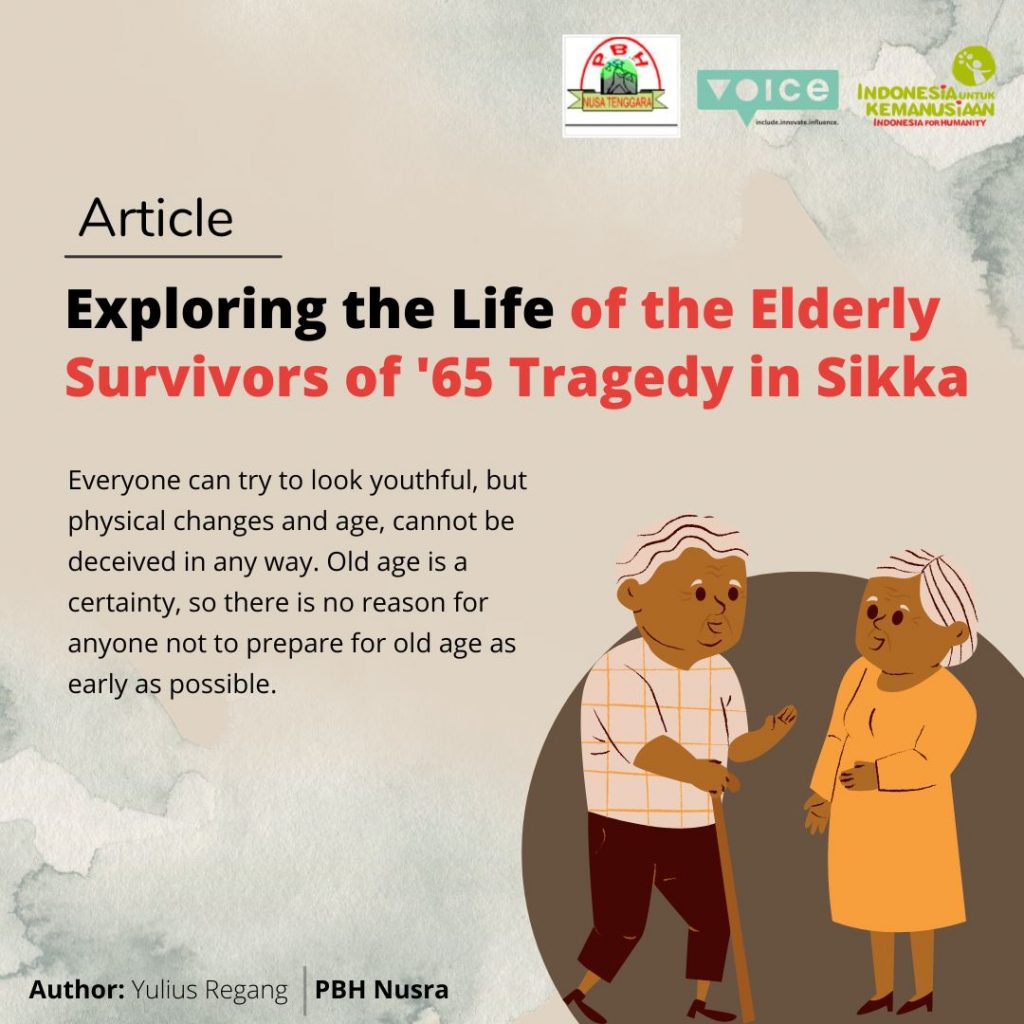
Exploring the Life of the Elderly Survivors of ’65 Tragedy in Sikka

Article published by PBH Nusra (NTT). Author: Yulius Regang

Getting old is not an option, but a cycle of life experienced by every human being. No one in this world can escape old age. Everyone can try to look youthful, but physical changes and age, cannot be deceived in any way. Old age is a certainty, so there is no reason for anyone not to prepare for old age as early as possible.

In fact, humans tend to ignore one phase in the life cycle, namely old age. People tend to overdo their youth and forget to prepare for old age. This is very real in the lives of local people in general. They spend their time with routine jobs until they forget to take care and prepare for the future properly. As a result, many elderly people cannot enjoy the rest of their lives properly and are far from prosperous. Situations and conditions that do not support also exacerbate the situation so that many elderly people experience violence and are abandoned by their families.

This condition automatically places the elderly in a helpless position because physically they are no longer strong, their immune system begins to weaken, eye function begins to blur, hearing no longer functions normally, memory begins to weaken, and various types of diseases come and go. This situation is experienced by the elderly survivors of 65.

The elderly assisted by PBH-Nusra are a group of survivors of past serious human rights violations that spread across three assisted villages: Ian Tena, Tua Bao, and Natarmage. There are 109 elderly people being accompanied. This number continues to decline from time to time because many elderly people are helpless due to age and illness.

For years the survivors lived in fear and are reluctant to open up to outsiders. They include people who experience layers of stigma and discrimination, are neglected, and do not get a good space in society. They find it difficult to express themselves because of stigma and discrimination. PBH Nusra seeks to restore their dignity by opening spaces for inclusion and fighting for the rights of the elderly to obtain services and social assistance from the state.

PBH-Nusra also involves young people as volunteers who are ready to help the elderly access basic services, especially in the health sector such as Posyandu (integrated service post) for the elderly, Supplementary Food Provision, and conducting home visits.

PBH-Nusra also tries to build meeting spaces that involve multi-stakeholders, including the government, the community, the elderly, young people, organizations, and individuals who care about the elderly. Small actions are carried out to give attention to the elderly and raise a sense of community concern, especially by the youth group towards the elderly. The problem faced by the elderly is not solely the responsibility of the state or government but is a shared responsibility.

All elements of society need to give attention and support to the elderly in accessing basic services and social assistance. Meanwhile, the government is obliged to ensure that the budget and work programs are in accordance with the needs of the community.

Good cooperation between the community and the government will result in the welfare of the elderly. In improving health and social services for the elderly, PBH-Nusra collaborates with Indonesia for Humanity, which is supported by Voice Global through the “Better Together” program in accordance with the mandate of Law Number 13 of 1998 concerning Elderly Welfare.

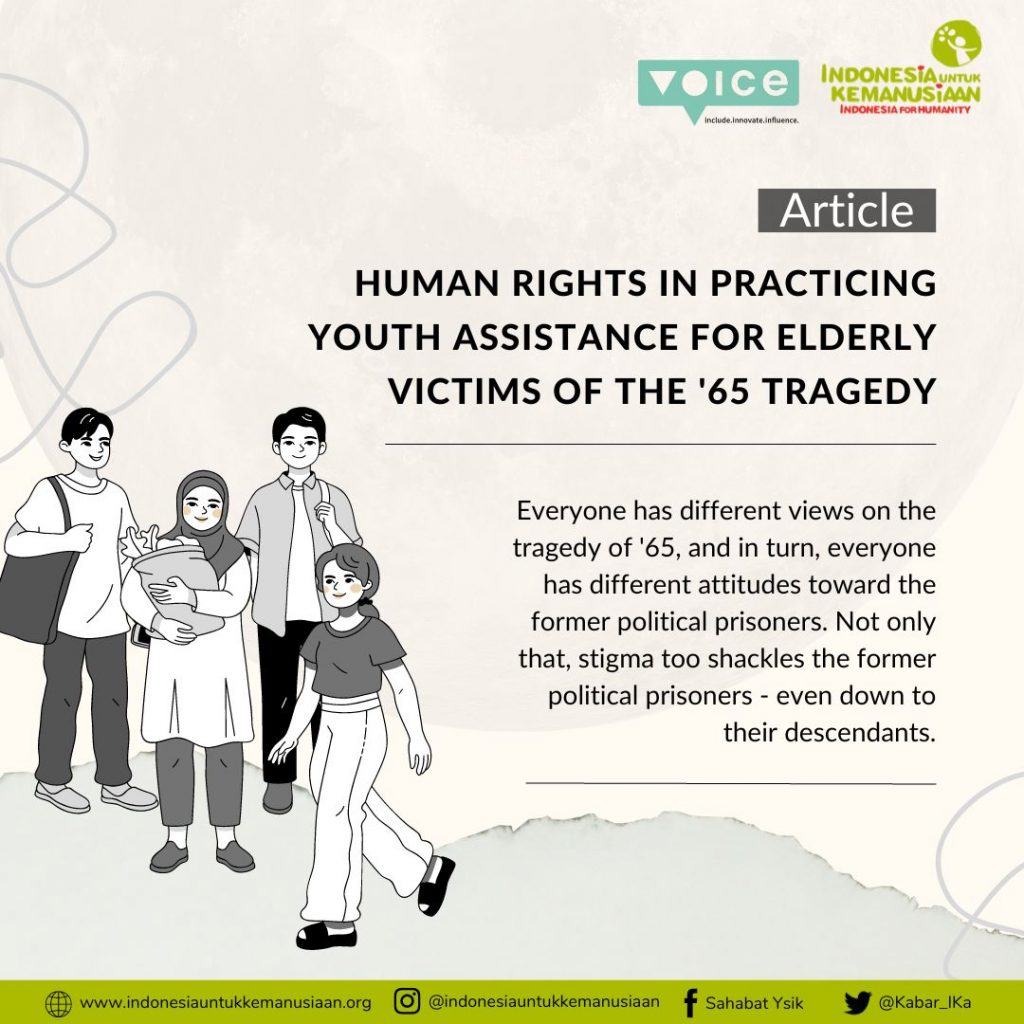
Human Rights in Practicing Youth Assistance for Elderly Victims of the ’65 Tragedy

Solo, a city with a million stories, from bliss to sorrow. The historical periodization seems to be centered in the city of Solo. From various historical stories, the ‘65 tragedy left a scathing wound to this day. This wound still needs a process to heal – and who knows how long. Our reflection was greeted by the heat of the city of Solo. The heat touched our skin as we were hauling our suitcases toward the pick-up vehicle. Some of us, just for the first time set foot in Bengawan Solo.

Everyone has different views on the tragedy of ’65. Different views make people have different attitudes towards former political prisoners. Stigma also shackles former political prisoners and even their descendants. In fact, according to our understanding, many former political prisoners are victims of the Old Order regime. They did not get justice even today. The state is negligent in its responsibility to protect its people. It is as if the state turns a blind eye to the fact that many former political prisoners are victims of the regime’s barbarity.

We are still recalling the moment of our visit to Mbah Cokro (not his real name). Mbah Cokro is a Simbah/Mbah (a nickname for grandfather in Javanese) who fights for the rights of the elderly victims of human rights violations. Mbah Cokro is highly respected because of his humanity spirit. Mbah told us how the political victims of the Old Order regime struggled in their lives. A long process was carried out even to make access to limited public services. Of course, opening a sealed door is not as easy as opening an unlocked door. This would describe how the quality of life lived by victims of human rights violations.

Mbah Cokro recounted the efforts that had been made. There are many twists and turns of conflict from the surrounding environment to the state apparatus they face, ranging from the difficulty of accessing green books (books for accessing free medical treatment services to hospitals) to the issuance of a Certificate of Victims of Human Rights Violations from the National Human Rights Commission which states that the state recognizes that human rights violations have occurred against the victim. But from all of these stories, here we will tell about how young people are involved with the elderly and become part of them. Our question to Mbah Cokro was, “What is the strategy that makes young people enthusiastic and willing to be part of the accompaniment work?”

While sipping a cup of coffee, Mbah Cokro began to tell the story of the process of inviting young people to work assisting the elderly victims of human rights violations. The most important thing in the strategy is to understand the character of today’s youth. According to Mbah Cokro, the character of young people today tends to be individualistic and pragmatic. This is due to the advancement of technology so that the culture of meeting each other and discussing is starting to fade. For this reason, the strategy taken is to provide meeting and discussion rooms according to the current situation, namely online.

However, meeting virtually is not easy to make a bonding relationship. For that, it is necessary to conduct offline meetings as well. This was then scheduled for a direct meeting at the Sekber’65 office in Solo. The initial meeting discussed a simple theme about the culture around them. This activity is effective in building curiosity among young people. This process also makes the youth’s background visible. Do these young people have any concern for the elderly victims of ’65 or are they new to this issue? Over time, these regular discussions took place, and several young people committed to attending. As a result, the discussion issues moved to heavier themes such as those related to human rights, democracy, protection for the elderly victims of human rights violations, and so on.

The curiosity of young people turned into empathy which was then formed in the Young Generation Forum (FGM). Mbah Cokro and his friends in Solo brought together young and elderly victims directly. From this, direct conversations and interactions occurred, at first young people only sympathized with the stories and films they encountered on online channels, now it has turned into a sense of empathy.

It did not stop there, the meeting of young people with the elderly became a moment that was never imagined before because these young people were invited to visit the homes of the elderly directly. Starting from the elderly who live alone, are rejected by their families, with economic limitations, suffering from certain illnesses, to the elderly who directly receive disabilities due to past tragedies. Not infrequently they (young people) are invited to visit the graves of the elderly who have preceded us.

The empathy that continues to grow makes young people in Solo want to join and become part of FGM. These young people do voluntary work to help the elderly victims, namely by providing assistance for control or check-ups at the hospital, home visits accompanied by a facilitator, to picking up elderly victims if they are not present or cannot be contacted. The humanitarian work of these young people illustrates that young people are not a generation that is indifferent to others, but young people are a generation that cares about others, especially the marginalized.

The activation of young people who are members of FGM changes the view that young people are an individualist and apathetic group. Young people have empathy which if managed properly can be a burning ember for the human rights struggle. Moreover, physically young people have strong stamina. On the other hand, along with the digitization of public services that the government is currently expanding to the regions, the performance of young people who are adaptive to technology is urgently needed. Collaboration between young people and supporting organizations is very good in the work of the human rights struggle.

Identifying civil society movements in the solidarity economy

Indonesia for Humanity (IKA) is holding a webinar “Cooperatives and CSOs: The Meeting Point of Economic and Social Movements in Practice” on August 3, 2021. This webinar is here to respond to concerns about upstream to downstream economic disruption faced by all elements of society in Indonesia. Civil Society Organizations (CSOs) which are the driving force of social movements that have the potential to bind community solidarity together to combat anxiety due to the economic turbulence they are facing.

Image: Presentation Slide of Romlawati (Co-Director of PEKKA). #1 Webinars

The webinar presents three resource persons who are competent in the solidarity economy movement, namely (1) Suroto from among researchers, observers, and practitioners of cooperatives; (2) Ukke R. Kosasih as the Board of Indonesian for Humanity (IKA); (3) Romlawati as Co-Director of the Implementation for Strengthening the PEKKA Economic Movement. The webinar lasted for three hours discussing the various links between Cooperatives and CSOs with approximately 100 enthusiastic participants participating to the end.

Humans who are often perpetrators, beneficiaries, and victims in economic activities must have various ways to continue to survive and increase independence. This will encourage how humans can be free from economic games by owners of large capital that threaten the benefit of human life in general. The existence of asymmetric power relations in controlling the economy, the position of the community continues to weaken economically. The reliance on the global economy shows evidence that a structured downturn has occurred.

Therefore, the solidarity economy movement must be able to encourage the creation of community independence that strengthens solidarity in community economic initiatives. Cooperatives as a financial institution are an element that can help the Indonesian people to build a community that is independent and does not necessarily exploit humans and the environment.

The FGD findings show that some facilitators still carry out direct mentoring work. This means that the role of the business world for community development competently is influenced by how a business entity can prioritize people over capital. Through the role of a business model that pays attention to community empowerment, the concept of profit oriented which can damage values ​​in a person then experiences a shift in perspective to be benefit oriented. How in these two concepts, the striking difference between them is when a business pays attention to the benefits in terms of value and competence given and received by them, compared to the profits in terms of the amount of income they face. This can be seen from how when a business model pays attention to the welfare of the elements of the workers in it, a profit factor will be achieved.

The cooperative model that develops the perspective of increasing competence instead of competition, creates solidarity and cooperation between business actors in it. In addition to business actors, consumers are also used as co-producer elements who have a role as capital owners and not only as objects of the target market. The creation of an economic democracy in society affects the increasing attention to the strengthening of human values, cultural wisdom, to ecological sustainability.

Profits from business results become a fuel in the solidarity economy movement that can strengthen resources for advocacy. In civil society organizations that are often based on a crowdfunding system, CSOs do not have a strong foundation to defend the movement they are fighting for. Through the establishment of cooperatives, business activities with their income can strengthen the social movement that civil society organizations will fight for.

PBH Nusra, Prospering in the Midst of the Covid-19 Pandemic in Sikka

The Nusa Tenggara Legal Aid Association (PBH Nusra) has been experiencing a number of set-backs in the provision of legal aid support to its constituents because of the Covid-19 pandemic. PBH Nusra is responding to the pandemic by providing face-masks, information billboards and holding public education sessions on the dangers of Covid-19.

PBH Nusra’s activities were initiated by a coordinating meeting with the Disaster Risk Management Forum (FPRB) to discuss the management of the Dengue Fever crisis and to anticipate the spread of Covid-19. This meeting took place at the Caritas Secretariat in Maumere diocese on 23 March 2020 with representatives from Caritas, Wahana Tani Mandiri (a farmers’ organization), PBH Nusra, the Regional Disaster Management Agency (BPBD), the Union of Catholic Students of the Republic of Indonesia (PMKRI) the Indonesian Red Cross (PMI).

Pundi Insani provides grants for rehabilitation and empowerment of victims of human rights violations. Currently, Pundi Insani is supported by the Peduli Program which aims to create a socially-inclusive movement to promote equality and dignity.

Pundi Insani: Building Social Inclusivity for the Talangsari Victims

The Association of Families of the Victims of Talangsari Lampung (PK2TL) held a meeting with the inhabitants of Rajabasa Lama Village in order to discuss strategies to strengthen the community by accessing village funds and in collaboration with students. The meeting was held on 29 January 2020 in the Talangsari prayer hall, Sabing Putra III, Lampung.

PK2TL also carried out comparative research of the Rajabasa Lama Women’s Group to learn about Kain Tapis, traditional woven cloth,on 27 February 2020 at the Tapis Jejama Studio. The production of Kain Tapis is a traditional craft of the people of Lampung which is woven from cotton thread and embroidered with motives and patterns using metallic, silver or gold thread. The comparative research is important bearing in mind that Tapis Jejama Studio often acts as reference for Kain Tapis exhibitions and thus has become an important resource for all matters concerned with Kain Tapis.

PK2TL also held an audience with the East Lampung District Social Services on 6 March 2020 in order to discuss the rehabilitation of the Talangsari victims that reside in East Lampung. A number of issues were identified that require follow-up action, including:

  • Support for the development of local knowledge in an area that has seen social conflict (provision of tools for arts and culture)
  • Various forms of support for local enterprise groups
  • Social Security (BPJS) provided by the Social Services, Health Services and other BPJS agencies for the families of victims and inhabitants of Talangsari who have yet to receive the Indonesia Sehat Card (Healthy Indonesia Card) which enables them to access free services.

Pundi Insani provides grants for the rehabilitation and empowerment of the victims of human rights violations. Pundi Insani is currently supported by the Peduli Program, which aims to create a socially inclsive movement to promote dignity in everyday activities.

Forum Group Discussion: Municipal Regulation on the Elderly and ‘Green Book’ MoU with the Witness and Victim Protection Agency

Sekber 65, an organization which represents the victims of the 1965 political tragedy, held a Focus Group Discussion (FGD) to disseminate the Municipal Regulation on the Welfare of the Elderly in Surakarta, Central Java, on 12 February 2020. This FGD was attended by members of the Regional Government Administration Agencies (OPD), the Regional Commission for the Elderly and the Senior Citizens’ Association to create a new Municipal Regulation regarding the Welfare of the Elderly in Surakarta, in particular those senior citizens that have suffered discrimination since the issuance of Surakarta Regional Government Regulation (Perda) No. 4 2019 in respect of Care for the Elderly.

In addition, Sekber 65 in partnership with the Witness and Victim Protection Agency (LPSK) signed an MoU to provide medical and mental health support in the form of free treatment at Moewardi General Hospital through the mechanism of the ‘Green Book’ and in line with the Social Security Implementation Agency (BPJS).

Unfortunately, because of the Covid-19 pandemic, members of Sekber 65 are unable to seek treatment at Moewardi General Hospital, as this hospital has been designated a Covid-19 hospital. As a result, even though they are sick and they are in possession of the ‘Green Book’ the victims are unable to receive treatment.Pundi Insani raises funding and resources for the rehabilitations and empowerment of victims of human rights violations. Pundi Insan is supported by the Peduli Program which aims to create a socially inclusive movement to promote dignity in everyday activities.

Senior Citizens of Yogyakarta Sing Together and are Healed by the ‘Green Book’

Fopperham, an NGO working on Human Rights and Education, has been providing support to senior citizens and survivors in Yogyakarta from January to March 2020. One of the activities was learning to sing the Panembrono together, with the aim of providing a forum for senior citizens and victims to meet (1/16). The Panembromo is a singing style that is performed in unison with or without music. There are a number of types of song that can be used for the Panembromo and the lyrics can be adapted depending on the event.

In addition, Fopperham also helped to provide healthcare facilities to the senior citizens and the victims by facilitating access to the Victim and Witness Protection Agency’s ‘Green Book’. This activity aimed to access to reparation services provided by the Victim and Witness Protection Agency (LPSK) from 24 October 2019 to 23 April 2020. These two activities were completed just before the Covid-19 pandemic took hold.Pundi Insani is the pillar that provides grants and resources for the rehabilitation and empowerment of human rights victims. Pundi Insani is currently supported by the Peduli Program which aims to create a socially-inclusive movement to promote the equal and dignified treatment of all.

Selalu dapatkan kabar terbaru dari kami!