In the new year, Jakarta was struck by a natural disaster. Floods overwhelmed five administrative regions of Jakarta. As a result, according to the National Emergency Response Agency (BNPB) a number of residential areas and highroads were submerged by the flooding with water levels reaching anywhere between 30 cm to 2.5 meters high.
The Head of the Communication, Information and Data Center (Kapusdatinkom) of the BNPB, Agus Wibowo, stated that there were at least 63 flooding locations in Jakarta and at least 31,232 inhabitants had been forced to seek refuge ,with at least 1,500 sheltering in 23 emergency coordination post in North Jakarta, one of which was located in Kapuk Muara.
These floods not only had an impact on adults, but also on children. Moreover, the impact was even worse for children. In the aftermath of the flooding a number of children remained sad and moody, with decreased motivation and enthusiasm, particularly for their studies.
This situation was made worse by the inability of their parents to provide psychological support to their children. Economic factors meant that parents had to focus on how to survive following the floods. “The aims of the activity today are, first, to see changes in the children’s behavior in the future so that they become role model adults. For example, learn not to litter the streets, to take care of the environment as well as flood management,” said Diena Hariani of Sejiwa, an organization that focuses on children and bullying, online addiction and pornography.
The impact of the floods on children is frequently overlooked. Sejiwa with support from Pundi Hijau provided services and activities to strengthen the motivation of child victims of the Kapuk Muara floods in order to motivate the children and encourage them to take care of their environment.
This is one of the ways Pundi Hijau and IKa provide support to communities. Pundi Hijau raises resources (grants, knowledge, networks and volunteerism) to rehabilitate and empower victims of and activists focusing on food sovereignty and ecological justice.
September 2019 is a month that won’t be forgotten by the people of Jambi. How could they? They were surrounded by smoke from the burning forests throughout the whole of September. And even at the end of the month the sky was still glowed dark red at 12.00.
The worst of the fires took place around Puding Village and Mekar Sari Village, Kumpeh Sub-district, Muaro Jambi District. Although rains fell in a number of areas, fire and smoke didn’t altogether disappear. A team from the Forest and Land Fires Unit still struggles to contain the fire, particularly in Kumpeh Sub-district.
The monitoring of Air Pollution Standard Index (ISPU) using the Air Quality Monitoring System (AQMS), recorded a concentration of particles of PM 10, indicating that the air was unhealthy and a danger to health. At least 63,554 patients were seen by the Jambi health center, the majority of which were suffering upper-respiratory tract infections and which resulted in four fatalities.
The education sector was also disrupted and schools were closed because the air quality had reached dangerous levels and caused health problems. This is evidenced by the air quality results. Economic activities were paralyzed, particularly because many fields and orchards were razed to the ground. Based on analysis of data obtained by Citra Satellite TM 8 and Sentinel 2 Satellite by the CIS team from Warsi Indonesia Community Conservation on 2 October 2019, at least 126,000 hectares of forest were burnt to the ground.
Because of the number of victims and the scale of the losses sustained, Indonesia for Humanity (IKa) in partnership with Mitra Aksi Jambi and under the umbrella of the Pundi Hijau program was able to raise a total of 9.9 million rupiah. We would like to give our heartfelt thanks to the people who donated to the fund which has helped our friends in Jambi to continue their struggle.
These public funds were distributed by providing masks, medication, and milk for children and infants. The Mitrak Aksi team also providing funding to the Farmers for Fires Response (KTPA) team in Catur Rahayu and Jatimulyo villages to carry out monitoring activities in locations impacted by the fires but which had yet to be contacted by local government.
In the taxi, Asmara tries to calm the thunder in her chest. She is still trying to catch her breath. She holds her hand to her forehead, which is in such pain, just like her heart. Rico’s abusive shouting is still ringing in her ears. She can hardly believe the swearing and insults that came out of the mouth of someone who she also knew as religiously observant,
Asmara is approaching 30 years of age, she is looking for a life-partner. Rico is a religious man who seemed kind and with a good background. They met at the church where they both worship and became lovers.
But their relationship did not run smoothly, even though the wedding arrangements have already been made. Rico is emotionally unstable it turns out, he can be a very good man, but he can also explode in a rage which he takes out on Asmara through acts of physical violence when something he doesn’t like happens.
This story is an excerpt from the novel, Switched Off by Abigail Sirait which will be published this coming February. Switched Off is Abigail’s first novel and which explicitly raises the issue of abusive relationships. Asmara, as the main protagonist, is portrayed as a victim of violence: verbal, physical and, eventually, financial abuse should her and Rico go ahead and get married.
According to Michael J. Formica, abusive relationships are relationships that are propelled by feelings of fear, inconsistency and insecurity. Perpetrators try to dominate and control their partner. This occurs because the perpetrator is afraid of appearing weak, and so makes every effort to maintain control over the victim.
The problem occurs when violence continues, the insecurity that the victim feels are eventually reproduced in the social values they hold. The victims are afraid that they won’t be loved, and in the end all too often opt to remain in an abusive relationship and adapt to the violence.
The story of Asmara and Rico is one of the very many cases of violence against women that are perpetrated in Indonesia. According to the National Commission Against Violence Against Women’s 2019 Annual Report, of the 13,568 cases of violence against women recorded, 9,637 took place in the domestic sphere (71%). Of this figure, 2,073 cases were perpetrated by a boyfriend against his girlfriend and 5,114 by a husband against his wife.
Abigail understands that violence against women is an ongoing phenomenon in Indonesia. Ironically, the perpetration of violence against women does not discriminate – it can happen to any women regardless of economic, ethnic, religious and educational background.
“The most difficult issue for women to overcome is when they are victims of financial violence. When the women has her potential to earn curtailed, she becomes dependent on her partner,” said Abigail on a visit to the Indonesia for Humanity (IKa) office.
“Switched Off tries to show the initial stages of the vicious circle of violence that women can find themselves in within the domestic setting. If Asmara goes ahead with her wedding, she will be on the receiving end of increasing levels of violence, particularly is she is told to quit her job. Why increasingly bad? Because in the end Asmara will be dependent on Rico, and Rico will be free to do what he likes to Asmara,” continued Abigail with passion.
Providing economic access to victims of domestic violence is key to ensuring that women can become self-sufficient and no longer dependent on their partner’ in order that they can renew their access to economic self-sufficiency that was stolen from them by their partner.
Through Pundi Perempuan, which is managed by Ika and the National Commission for Women, Abigail has made a valuable contribution to dealing with the issue of violence against women in Indonesia by donating the profits from the sale of Switched Off which will be published this coming February. Let us hope that public support for this important issue will continue to flow.
Women and violence are too often words that come together in one sentence today. How so? In 2019, 406,178 cases of violence against women were recorded in Indonesia according the National Commission for Women’s annual report. This is a significant increase in comparison to the previous year’s recorded total of 348,466 case.
“We were shocked by the fact that cases of violence in the domestic sphere have increased, with physical violence the most dominant form of abuse,” stated Deputy Head of the National Commission for Women, Yuniyati Chuzaifah.
Many different types of support are required when dealing with cases of violence against women including psychological, legal, social and not forgetting financial support.
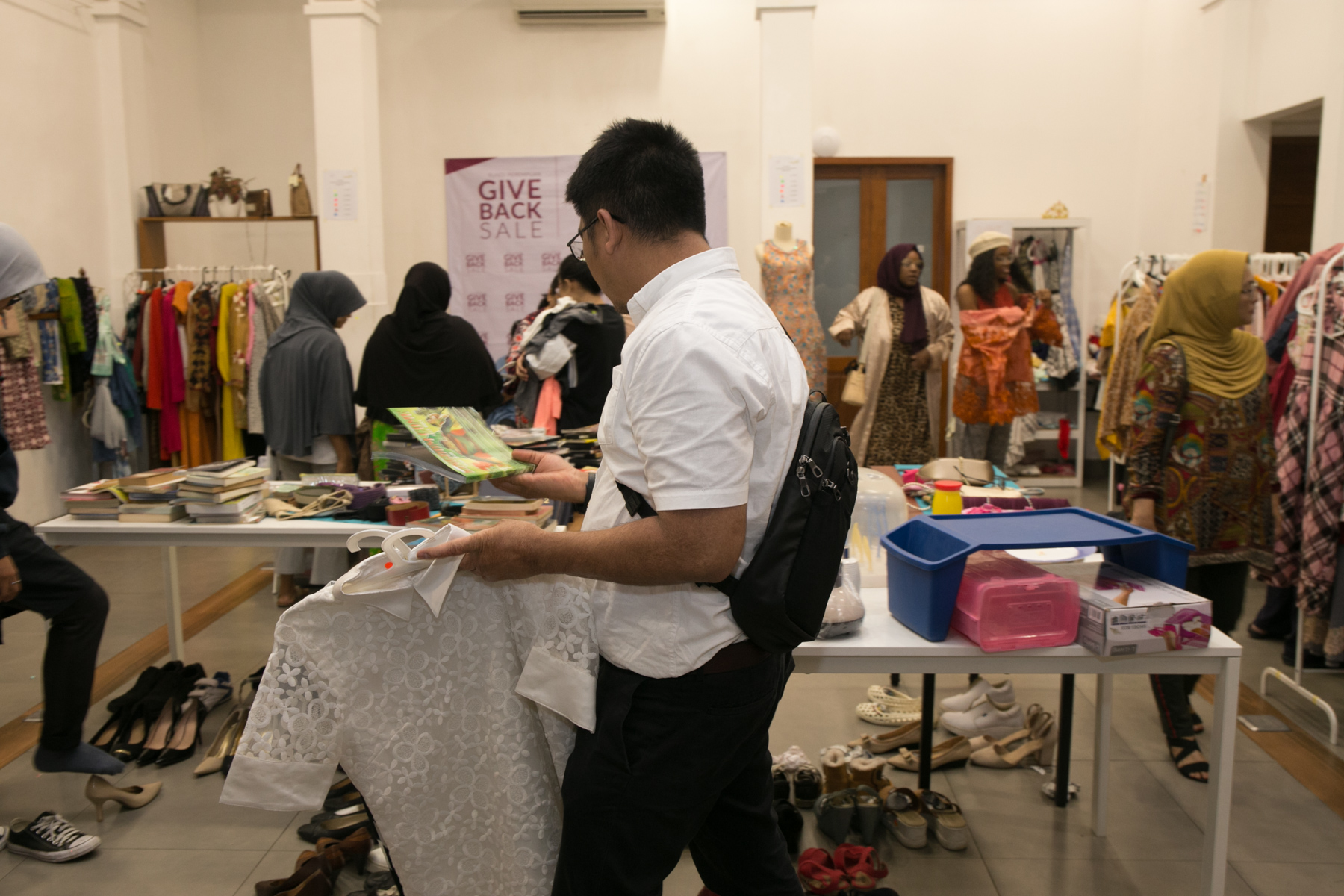
In order to increase the minimal financial support available to women victims of violence, Indonesia for Humanity (IKa) works in partnership with the National Commission for Women and commercial online platform Blibli.com to hold a Give Back Sale as a means to raise funding through the sale of pre-loved goods which was held at Ke:Kini, a co-working space located at 45 Cikini Raya Street, Central Jakarta, on 4-7 December 2019.
The Give Back Sale raised a total of 73,391,250 rupiah through the sale of goods donated by 134 donor and purchased by 342 shoppers from a variety of backgrounds. In parallel with the Give Back Sale, a series of events was held including film-screening and discussions, tarot card readings, healing therapy sessions, Purple Yoga for Women, musical performances, the launch of the EmpujalinkarsA Fashion line and beauty classes in partnership with Mustika Ratu. Refreshments were provided by the Sondang Coffee House Roastery. A percentage of their profits for the day were donated to Pundi Perempuan.
Increased participation in the 2019 Give Back Sale from a diversity of people and organizations shows that progress is being made in the effort to provide support to women victims of violence in Indonesia. The increased participation is evidenced by the number of organizations involved in the 2019 Give Back Sale in comparison to previous years.
Income from the sale will be used to support women victims of violence via service provider organizations, women’s crisis centers and human rights defenders via the Pundi Perempuan program which is managed by IKa.Pundi Perempuan grants are intended for groups and communities that do not have routine access to resources but which have the potential to grow. Communities are selected in partnership with the National Commission for Women that initiated the establishment of Pundi Perempuan. Resources, particularly grants, networks and knowledge are shared in order to empower small groups so that they can increase their service provision and go on to receive further funding and work in a more transparent and structure way towards eradicating violence against women.
In the corridors of the Faculty of Sociology and Politics of Sebelas Maret University (UNS), a number of students are entranced by row upon row of photographs exhibited there. The photographs tell the stories of victims and survivors that still struggle to navigate the difficult path to justice and equal access to the benefits of development. Seven narratives from seven different regions are recounted through those photographs, from North Aceh, to East Lampung in Sumatra, from Jakarta and Surakarta on the Island of Java to Palu in Central Sulawesi and Sikka in Flores.
These photographs recount stories that very few students are already aware of. Stories of sweat, tears and bloodshed, stories that can be told in many ways in order that they be passed on to future generations. Not least to ensure that these tragedies are never repeated.
One of the stories that has drawn a lot of attention is entitled When the State Says Hello, which tells the experience of the victims of the 1965 political tragedy in Surakarta, the story of the survivors that have obtained access to medical and psychological care from the Witness and Victim Protection Agency (LSPKK) following receipt of Victim Information Document from the National Commission for Human Rights (Komnas HAM). The ‘Green Book’ that they receive from the LSPKK not only enables the victims and survivors to access healthcare, but is also a sign that the state has acknowledged their plight and is treating them in the same way as other citizens.
Many people say that the youth of Indonesia have forgotten about gross human rights violations, but that doesn’t seem appropriate. It’s not that they have forgotten, it’s that they have not been made aware in the first place as many past human rights abuses have not been revealed to young people.
“Honestly, I am only just finding out about gross human rights violations, that these events are part of my life as a student. And this is only because I have been active in various discussions that have been held by my organization. I am fortunate, but what about other young people who aren’t as lucky as me,” said Erma Alfionita, Head of the UNS Sociology Students Association.
It is an open secret that the youth have been force-fed a historical narrative created by the government, particularly previous governments. This narrative does not talk of the humanitarian tragedy from the perspective of victims and what they have been subjected to. There has been no comprehensive discussion in school history books.
It is important to bequeath these stories to young people in order that past tragedies are not repeated, so that those that are still missing or who have died are not forgotten. Efforts to raise awareness about human rights are being developed in a range of diverse ways and by many different parties, including youth groups, artists, academics, cultural organizations and victim/survivor groups. This is one of Indonesia for Humanity’s (IKa) areas of work by collaborating with and providing support to victim/survivor groups and other civil society organizations (CSOs) with the Peduli Program.
The Peduli Program works on poverty eradication with an inclusive development approach that ensures that marginalized communities are able to participate in and benefit from development. Indonesia for Humanity acts an umbrella organization for the victims of gross human rights violations including: Victims of the Military Operational Region policy in Aceh, Victims of the 1965/66 humanitarian tragedy in Yogyakarta, Surakarta and Sikka, Victims of Talangsari-Lampung and Victims of the 1998 riots in Jakarta.
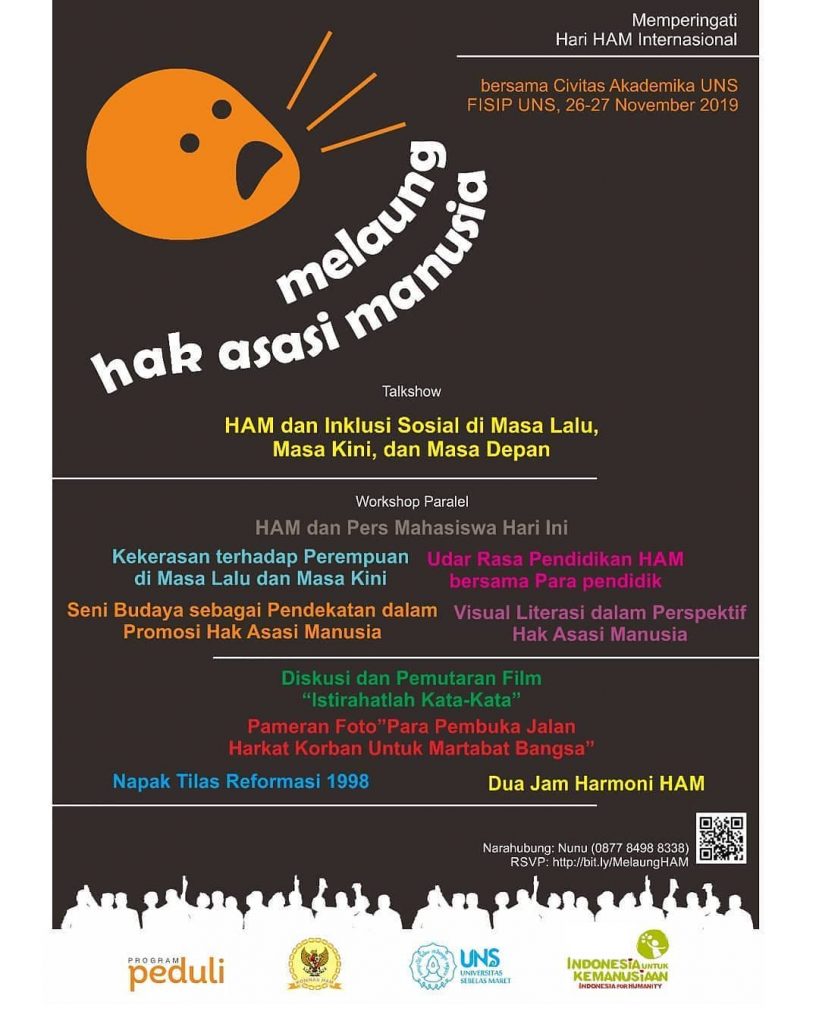
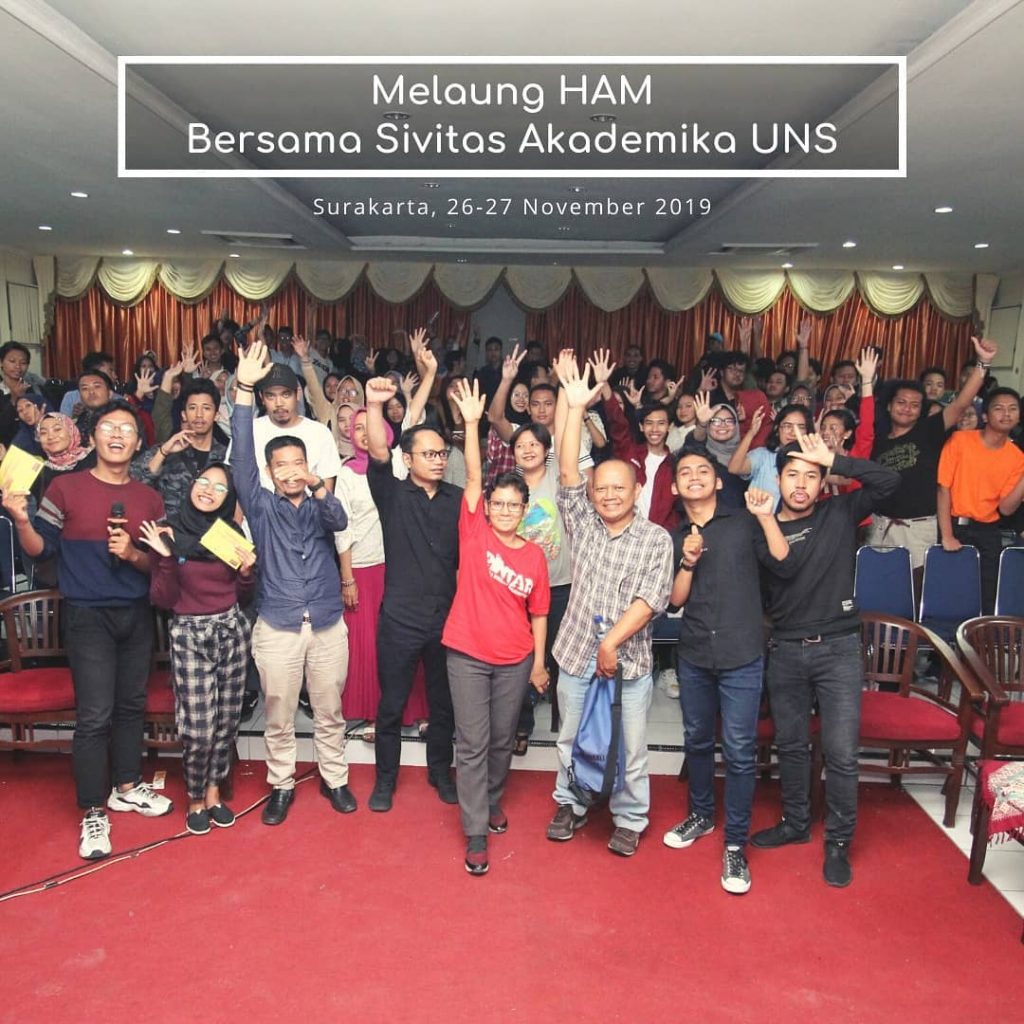
In order to commemorate International Human Rights Day on 10 December 2019, Indonesia for Humanity (IKa) will hold the event, Howl for Human Rights in collaboration with Sebelas Maret University (UNS), and with the support of the Peduli Program. This event will be held on 26–27 November 2019.
In order to attain these aims, Komnas Ham, the UNS Faculty of Sociology and Politics (FISIP) and IKa with the support of the Peduli Program will hold the event, A Howl for Human Rights, together with UNS. This event will take place over two days and will introduce the concepts and practices of human rights and social inclusion to the academic community through activities such as public seminars, parallel workshops, photography exhibition, musical performances and by tracing the history of 1998 political reform.
This event is a follow-up to the signing of an MoU between Komnas HAM and UNS on 1 November 2018. The MoU was signed by the Head of Komnas Ham, Ahmad Taufan Damanik and the Rector of UNS, Prof. Dr. Ravik Karsisi, MS. The two parties agreed to collaborate in order to promote Human Rights on the basis of Indonesian Higher Education’s values of Tri Dharma, and which aims to strengthen the implementation, protection and respect of human rights as well as strengthening institutional synergy between the two organizations.
In addition to sharing the stories of the victims/survivors and to strengthen commitment to resolving human rights issues, this event will introduce the concepts and practices of human rights and social inclusion to the academic community through activities such as public seminars, parallel workshops, photography exhibition, musical performances and by tracing the history of 1998 political reform.
Opening up a Forum for Inter-Generational communication
“We can find out about gross human rights violation from books, but of course it is different if we have the opportunity to meet with and discuss human rights directly with victims and human rights defenders,” said Erma.
Bringing young people together with actors of history is one of the main aims of this event. Opening up a space to meet and discuss is expected to increase the concern of young people towards human rights issues in Indonesia, be they in the past, the present or the future. Inter-generational communication can help heal memory which has perhaps been worn down by the onslaught of old narratives that the government is trying to revive again.
The talk show Human Rights and Social Inclusion in the Past, the Present and the Future aimed demonstrate the fact that human rights are something close to us, something dynamic. So we need materials that help us heal human rights in the midst of the political upheaval of Indonesia today.
Following the talk show, the UNS Faculty of Sociology and Politics and Komnas HAM signed an agreement to collaborate together on the promotion of human rights via a program entitled Howl for Human Rights Together with the Students of Sebelas Maret University. The agreement was signed by the Dean of the Faculty of Sociology and Politics, Dr. Ismi Dwi Astuti Nurheani, M.Si and the Commissioner for Education and Counseling, Komnas HAM, Beka Ulung Hapsara.
Discussion on different approaches to addressing human rights issues was held in a number of parallel workshops, according to individual expertise, from violence against women, cultural approaches to resolving human rights violations, student press and human rights, human rights education and visual literacy in human rights approaches.
A musical performance entitled Dua Jam Harmoni HAM (Two Hours of Human Rights Harmony) provided an example of how the arts, and music in particular, can be used as part of the campaign to increase awareness of human rights issues. The musical program included performance from the UNS Faculty of Sociology and Politics Music Community, Nganthi Wani X, Julian Rinaldi, Sisir Tanah and Bonita & Adoy. The performances provided both entertainment and an opportunity to discuss issues directly with the survivors in attendance, and an opportunity to enjoy the music together.
Istirahatlah Kata-kata, (released in English with the title Solo Solitude), a film that recounts the story of poet-activists from Solo, Wiji Thukul, a victim of forced disappearances in 1997/1998, provided another opportunity for discussion and the exploration of human rights violations in Indonesia. The film’s producer, Yulia Evina Bhara, took part in the discussion, as did Tonny Trimarsanto (a filmaker) and Zaenal Muttaqien (member of IKOHI, Ikatan Keluarga Orang Hilang Indonesia – the Association of Families of the Disappeared).
The last event, Napak Tilas Reformasi 1998 (On the Trail of 1998 Political Reform), provided participants with the opportunity to trace and learn about the locations and events that led to political reform in 1998, and to share stories of these historical events by visiting the actual locations.
“The Napak Tilas event is fantastic because we get to visit these historic locations in Solo. We knew about history from books, but with Napak Tilas we can really learn about history in another way, more directly,” said Naufal Amar, one of the participants.
In addition to the students, five Peduli Program partners also attended A Howl for Humanity, namely the IKOHI Federation, FOPPERHAM (Forum Pendidikan dan Perjuangan HAM – Education and Human Rights Forum), RPuK Aceh (Relawan Perempuan untuk Kemanusiaan – Women Volunteers for Humanity), Central Java Sekber ’65 (Sekretariat Bersama – an organization that represents victims of the 1965 political tragedy) and PBH Nusra (Perhimpunan Bantuan Hukum Nusa Tenggara – Nusa Tenggara Legal Aid Foundation). In addition, a number of survivors from Solo and Yogyakarta took part in the event and shared their stories and experiences.
What Next?
Opening up an inter-generational space for discussion, is like handing over a key to a generation. We don’t know what is going to happen because they have their own imagination. They will use that key to open many doors to a wealth of information. They can invite their friends and share the key to open doors that are stuck in the silence. The can also duplicate the key they have been given and share them further so that these stories will never die.
What happens following the closing of the Howl for Humanity event at UNS is beyond our expectations. According to Erma, many students from the Sociology Department have chosen human rights, specifically past gross human rights violations, as their research topic. Moreover, the Faculty of Culture at UNS decided to host a discussion about past gross human rights violations, involving a number of human rights activists, the following week.
In order to commemorate International Human Rights Day on 10 December 2019, Indonesia for Humanity (IKa) will hold an event in collaboration with Sebelas Maret University (UNS). This event will be held on 26–27 November 2019.
This event is a follow-up to the signing of an MoU between the National Commission of Human rights (Komnas HAM) and UNS. The MoU was signed by the Head of Komnas Ham, Ahmad Taufan Damanik and the Rector of UNS, Prof. Dr. Ravik Karsisi, MS. The two parties agreed to collaborate in order to promote Human Rights on the basis of Indonesian Higher Education’s values of Tri Fharma, and which aims to strengthen the implementation, protection and respect of human rights as well as strengthening institutional synergy between the two organizations.
In order to attain these aims, Komnas Ham, the UNS Faculty of Sociology and Politics (FISIP) and IKa with the support of the Peduli Program will hold the event, A Howl for Human Rights, together with UNS. This event will take place over two days and will introduce the concepts and practices of human rights and social inclusion to the academic community through activities such as public seminars, parallel workshops, photography exhibition, musical performances and by tracing the history of 1998 political reform.
It is hoped that this event will lead to opportunities to increase mutual understanding and awareness of the importance of social inclusion in the development of the academic community, as well as an exchange of knowledge and inter-generational learning.
What is Melaung?
According to the Indonesian Dictionary, the word melaung means to call out with a loud and piercing voice; to scream out loud or howl.
What is the Peduli Program?
The Peduli Program works on poverty eradication with an inclusive development approach that ensures that marginalized communities are able to participate in and benefit from development. Indonesia for Humanity acts an umbrella organization for the victims of gross human rights violations including: Victims of the Military Operational Region policy in Aceh, Victims of the 1965/66 humanitarian tragedy in Yogyakarta, Surakarta and Sikka, Victims of Talangsari-Lampung and Victims of the 1998 Riots in Jakarta.
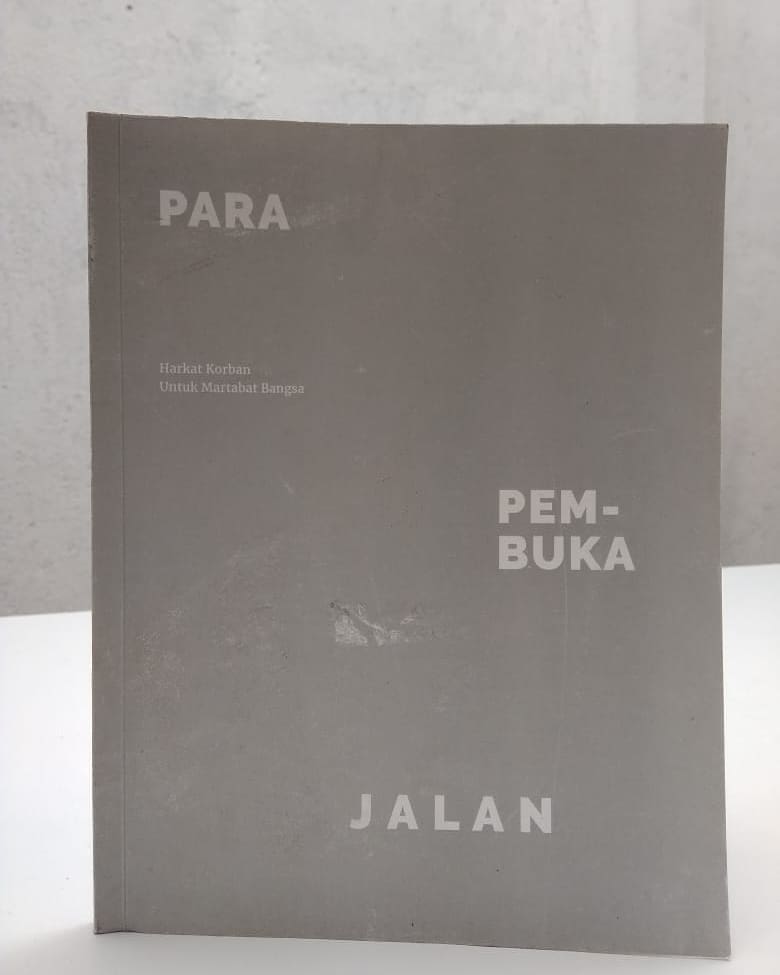
The Pathfinders is a non-fiction photography book which recounts the life journey of victims of past gross human rights violations. The book is published by Indonesia for Humanity (IKa) with support from The Asia Foundation via the Peduli Program. This 106-page book was published in August 2019 and is filled with photographs with accompanying text written by Lilik HS of Pundi Perempuan, IKa
This photo-book is a portrait of the lives of the victims/survivors today, and their road to rehabilitation with victim support communities and the public.
The first section contains images of couples, of husbands and wives. What is special about this? These couples are just some of the thousands of couples that from 1976 right up until the signing of the peace agreement in 2015 were victims of the conflict in Aceh. During this period, many marriages were unofficial because the conflict disrupted government services, with the greatest impact felt by people living in the interior of the province. As a result, many couples do not possess marriage certificates, which means in turn that their offspring are unable to access government services. “Our life was disrupted, we were not acknowledged by the state,” said Hasan Ajad and Halimah, one of the couples that were victims of the conflict.
The second section recounts the feelings of vengeance and uncertainty that have accumulated over the years, and the opportunity that the victims/survivors eventually found to make peace with themselves and with their communities. A traditional ceremony held at village level provided the first small step and opened up the space for recognition and dialogue between the perpetrators and the victims of the events that took place 54 years ago during the 1965/66 political tragedy.
It’s not only the victims that are shrouded by grim shadows; the families of the perpetrators are also covered by a feeling of guilt and the social burden of the mass killings that their relatives perpetrated. Because of the traditional ceremony, they are now able to build their lives again with greater peace and without the burden of the past.
This book also describes one of the state’s rehabilitation initiatives for victims of past gross human rights abuses, namely the ‘green book,’ in a chapter entitled “Medical and Psychological Support Provision from the LPSK.” The ‘green book’ is a document issued by the Witness and Victim Protection Agency (LPSK) to victims who have obtained the ‘Victim Information Document’ known as Sukket from the National Commission for Human Rights (Komnas HAM). This document enables victims to receive free medical services and support in accessing medical services.
“This enables me to get free treatment. The state pays,” said Wahyono (76) whilst showing his Sukket from Komnas HAM to one of the customers at his satay stall. He set up his stall in front of his house and with this document he is able to receive free medical treatment. The injuries he suffered to his legs due to torture were x-rayed and treated. Now, he no longer feels pain every day. In 1965 he was a civil servant working in the Surakarta Municipal Hall who was accused of being a member of a outlawed organization and arrested.
The next chapter recounts how weaving became a source of income and life support for women in Sigi whose husbands had been arrested and imprisoned. The Victims of Human Rights Abuses Solidarity organization (SKP-HAM) in Central Sulawesi promoted a return to weaving as part of their efforts to organize the victims/survivors, as weaving is part of who they are.
The many interesting photographs in this book try to show the optimism of the pioneering efforts made to fulfill the economic, social and cultural rights of victims and survivors of past gross human rights violations. These efforts are based on hard work to prevent the repetition of human rights violations in the future and to safeguard the humanity of the Indonesian people.
Because she questioned the volume of the mosque loud speaker, Meliana was sentenced to 1.5 years’ imprisonment. Indonesia for Humanity (IKa) provided support to Meliana in order to resolve her case.
Meliana is an ethic Chinese woman, born and brought up in the town of Tanjung Balai, North Sumatra. She has four children and sells salt fish. Meliana’s day to day activities are the same as the other women in her area; she leaves home in the morning and works until the evening, she lives in a friendly neighborhood where everyone greets one another.
However, her life changed drastically on 22 July 2016. On that date, at around 07.00 in the morning, Meliana was buying provisions at Mrs Uwo’s stall. While chatting, Meliana said: “Mrs Uwo, the sound of the mosque loud speaker didn’t used to be as loud as this did it Mrs Uwo?” and then she returned home.
A world turned upside down
On 29th July 2012 at around 19.00 in the evening, five men went to Meliana’s home, accusing her of calling for a ban of the call to prayer. At the same time, a crowd gathered outside her house. Meliana’s husband, Mr Lian Tui, went directly to the Al Maksum mosque to apologize to the mosque authorities.
Nevertheless, at around 20.00 the same evening the local security and police officers went to Meliana’s home and asked her to accompany them to the local administrative headman’s office as news that ‘a Chinese woman had prohibited the call to prayer’ was spreading fast around Tanjung Balai. Consequently, Meliana’s home was attacked, stones thrown through her windows and the front of the house set on fire.
From that day on, Meliana had to face many changes to her life. She was under investigation from 26 July 2916 to 30 May 2018, at which point the case was considered ready for trial. Meliana was detained on 30 May 2018 and held in Tanjung Gusta prison in Tanjung Balai, Medan, as the case was to be tried in the Medan State Court.
The first hearing was held on 25 June 2018. There were 12 hearings held in total leading up to the day when the judges reached their decision on 20 August 2018. Meliana was subjected to harassment and abuse from the crowds in attendance throughout the trial, including those from the Medan Belawan Islamic Umma Forum. They shouted and screamed threats and insults at her and the judiciary.
These conditions increased the trauma that Meliana experienced throughout the process. In her pain, her tears streamed down her face as she recounts her emotions and the things she experienced during the trial.
The judges announced their decision on 20 August 2018, handing down a sentence of 1.5 years’ imprisonment. Meliana decided to appeal the decision even though she was unsure whether she should appeal or not. Her indecision was based on considering her children who had already suffered: reading news about their mother’s case was unavoidable. Meliana was also thinking about her family’s safety. However, based on the advice of her legal team she agreed to appeal the court’s decision on 24 August 2018.
Pundi Perempuan Support for Meliana
Throughout her ordeal Meliana received support from a number of different sources, including organizations and individuals such as the United North Sumatra Alliance (Aliansi Sumut Bersatu), Deva Sebaya, a religious teacher from Medan, the National Commission for Women, Gajah Mada University Faculty of Law, Onename Foundation Jogjakarta (Yayasan Satunama Jogjakarta) and the PETRASA Foundation from Sidikalang.
Indonesia for Humanity (IKa) provided a grant of 20 million rupiah to support Meliana via the Pundi Perempuan grant to help cover the cost of meetings and the preparation of trial documents, counselling services, expert witnesses and consultants as well as the travel of supporting organizations from Medan and Jakarta. The handling of this case required a number of different strategies and approaches. The psychological needs of the family, particularly Meliana’s husband and her youngest child who actively supported her to face her fears and trauma. It will take a long time for Meliana and her family to heal.