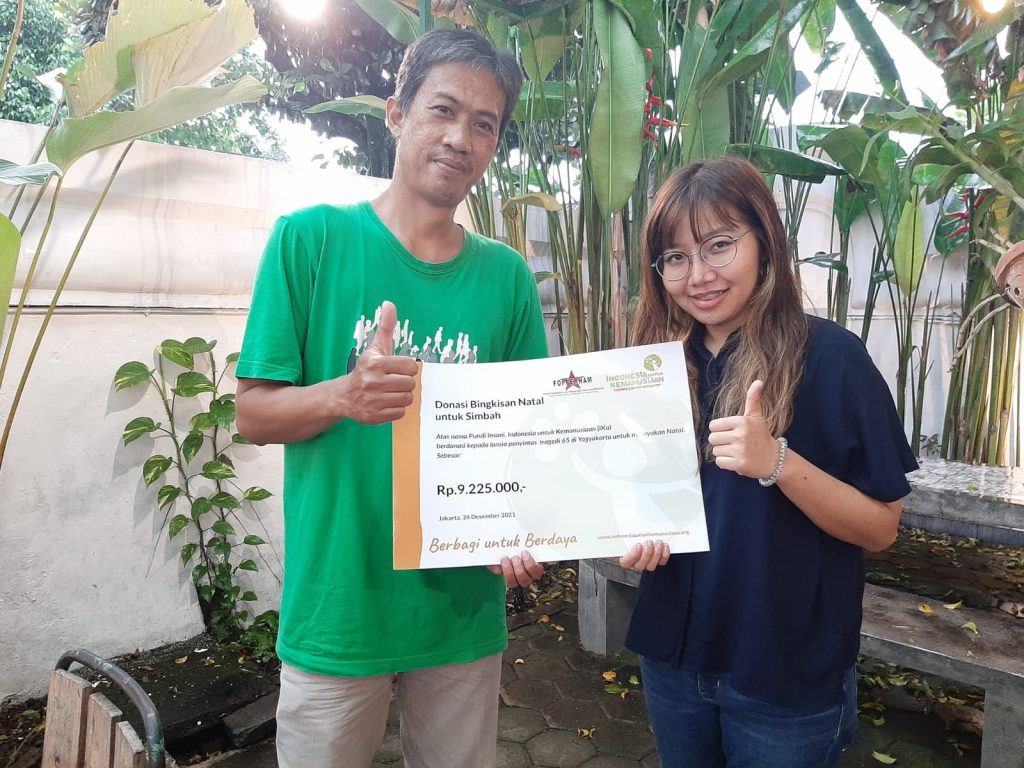
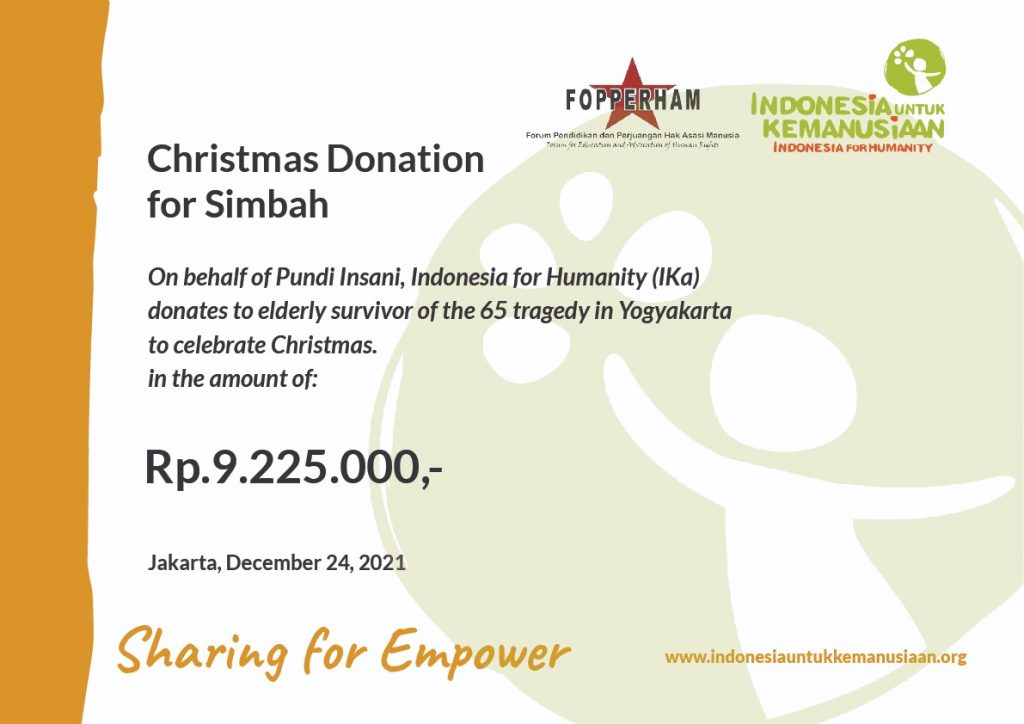
Indonesia for Humanity (IKa) and Fopperham held a fundraising event for Pundi Insani for the 2021 Christmas Gift for the elderly of Tragedy ’65 survivors, which was held on 16 – 23 December 2021. The final result of the fundraising was a donation of Rp. 9.225.000,- (nine million two hundred twenty five thousand rupiahs). The donation has been handed over by IKA to Fopperham. In the future, Fopperham will distribute it to the elderly of Tragedy ’65 survivors in Yogyakarta.
The handover of the Pundi Insani donation from IKa’s represented by Priscilla Sharon to Fopperham’s represented by Mas Andon.
Indonesia for Humanity (IKa) and Fopperham would like to thank you for the donation support from IKa’s friends. May this year’s Christmas bring peace to all of us, and may the coming year 2022 make us fresher and healthier.
Indonesia for Humanity (IKa) looks forward to other humanitarian actions to always pay attention to humanitarian issues. Let’s join Indonesia for Humanity by becoming a youth volunteer for Humanity.
Like the other parts of East Nusa Tenggara (NTT), Lembata geography is surrounded by five volcanoes and seas that become the hidden gem of the province. The beauty does not only attract the locals, but also national and international attention. Yet, at this time, the beauty has been swept off with the flood on 4 April 2021. The flood was called the greatest disaster in the last 10 years in NTT. At the beginning, it was raining heavily, which was strong enough to push the rocks over the hills to the mountain feet and lowlands sides. Causing the rocks to damage the residents’ houses. At the same time, the sea water level was rising, thus complicating the already severe condition.
6 out of 9 districts in Lembata were affected by the great disaster. Out of 6 districts, East Ile Ape is the most affected by the flood. Because the eruption that has been going on since November last year, is still occurring to this day. Even though the disaster was small in scale, it still left major detrimental effects such as the loss of school building, houses that worsened the already poor education and economic landscape in the area.
One of many flood victims that was impacted was Mama (Mother) Rensa. This mother is one of East Ile Ape residents that saw and felt the horror of this disaster first hand. The flood happened in the evening, right after two heavy rains. At the time, Mama Rensa was at home with her husband and children. So, when the flood was already happening, Mama Rensa still had time to pack their belongings before taking shelter to the house at higher grounds. Yet, when she was about to leave her home, the flood was already high-rise, and Mama Rensa ended up having to find the closest shelter to her home. During her travel to the shelter, many challenges were up ahead. For example, Mama Rensa was hit with the rocks. And when she was in the emergency post too, Mama Rensa faced other challenges.
The emergency posts are divided into the public emergency posts and the private emergency posts. In general, the public posts are more equipped with facilities such as electricity, clean water, enough food, and clothes. Not only that, the public posts are also equipped with stand-in health workers, and psychosocial workers. Yet, this is another different case with the private post such as the one that Mama Rensa was in. The private post is divided into the private post in the towns, local residents’ houses as well as the farms. Currently, Mama Rensa was in the private post in a local residents house that supposedly has better conditions. Yet, the private post in the residents’ farms faced many limitations. The majority of refugees in the private post chose to stay because they desired to stay alongside the late family members that lost their lives in the flood. And to fulfill the needs, the refugees have to rely on the electricity from the nearest village, they have to travel to pick up the assistance. Out of concern for health, the health workers were also visiting the victims in the private post, yet their availability was also limited.
Many detrimental effects emerged from the disaster, from destroyed and damaged houses, damaged school buildings, damaged Integrated Health Centre buildings, damaged public infrastructure and raised many casualties as well. To date, there have been 60 casualties and 20 people remain missing. Regardless of the grim occurrence, the Local Government was still sluggish in dealing with the disaster, from the late response that caused the activists to fill up the government shoes, to the rushed decision to stop the search for the missing people. Because of the difficulty in reaching several locations. Before the disaster, the road infrastructure in Lembata had already been poor and the flood disaster had further worsened the infrastructure landscape.
Almost none left out of East Ile Ape. And knowing this, Mama Rensa is really pessimistic about going back and staying in East Ile Ape again. The sadness was not only felt by the local people of Lembata but the people across Indonesia. Many assistance arrived to help Lembata back on its feet again. Public figures to the President of the Republic of Indonesia, visited the affected areas to provide support for them. Alongside the local activists, health workers, Lembata could rise up again. One that took the crucial role is Mrs. Maria Loka, the activist of Lembata that leads the organization, NGO of Permata that works in assisting the Violence Against Women (VAW) victims in Lembata. Apart from her responsibility in dealing with VAW crisis that often found even amidst the disaster, Mrs. Maria Loka was also responsible as a volunteer in the Lembata Flood Disaster. She alongside her volunteer friends, worked to help the psychosocial assistance for the children and the flood victims which was still very rare in Lembata. Eventually, the assistance was not only helping Lembata and its residents but also solidifying the Lembata itself. We are hoping that the lights such as Mrs. Maria Loka could always exist and become the luminous spots to the local residents.
Indonesia for Humanity (IKA) is holding a webinar “Cooperatives and CSOs: The Meeting Point of Economic and Social Movements in Practice” on August 3, 2021. This webinar is here to respond to concerns about upstream to downstream economic disruption faced by all elements of society in Indonesia. Civil Society Organizations (CSOs) which are the driving force of social movements that have the potential to bind community solidarity together to combat anxiety due to the economic turbulence they are facing.
Image: Presentation Slide of Romlawati (Co-Director of PEKKA). #1 Webinars
The webinar presents three resource persons who are competent in the solidarity economy movement, namely (1) Suroto from among researchers, observers, and practitioners of cooperatives; (2) Ukke R. Kosasih as the Board of Indonesian for Humanity (IKA); (3) Romlawati as Co-Director of the Implementation for Strengthening the PEKKA Economic Movement. The webinar lasted for three hours discussing the various links between Cooperatives and CSOs with approximately 100 enthusiastic participants participating to the end.
Humans who are often perpetrators, beneficiaries, and victims in economic activities must have various ways to continue to survive and increase independence. This will encourage how humans can be free from economic games by owners of large capital that threaten the benefit of human life in general. The existence of asymmetric power relations in controlling the economy, the position of the community continues to weaken economically. The reliance on the global economy shows evidence that a structured downturn has occurred.
Therefore, the solidarity economy movement must be able to encourage the creation of community independence that strengthens solidarity in community economic initiatives. Cooperatives as a financial institution are an element that can help the Indonesian people to build a community that is independent and does not necessarily exploit humans and the environment.
The FGD findings show that some facilitators still carry out direct mentoring work. This means that the role of the business world for community development competently is influenced by how a business entity can prioritize people over capital. Through the role of a business model that pays attention to community empowerment, the concept of profit oriented which can damage values in a person then experiences a shift in perspective to be benefit oriented. How in these two concepts, the striking difference between them is when a business pays attention to the benefits in terms of value and competence given and received by them, compared to the profits in terms of the amount of income they face. This can be seen from how when a business model pays attention to the welfare of the elements of the workers in it, a profit factor will be achieved.
The cooperative model that develops the perspective of increasing competence instead of competition, creates solidarity and cooperation between business actors in it. In addition to business actors, consumers are also used as co-producer elements who have a role as capital owners and not only as objects of the target market. The creation of an economic democracy in society affects the increasing attention to the strengthening of human values, cultural wisdom, to ecological sustainability.
Profits from business results become a fuel in the solidarity economy movement that can strengthen resources for advocacy. In civil society organizations that are often based on a crowdfunding system, CSOs do not have a strong foundation to defend the movement they are fighting for. Through the establishment of cooperatives, business activities with their income can strengthen the social movement that civil society organizations will fight for.
In order to strengthen the solidarity economy movement, Indonesia for Humanity (IKa) again held a second webinar on August 25, 2021 with the title “Civil Society Organizations (CSOs) Connectedness in a Solidarity Economic Ecosystem”. This webinar explores the relationship between social movements and economic movements as outlined in a civil society organization. As a principle, solidarity economy can be applied in a social movement by taking into account the values of solidarity, cooperation, equality, sustainability, democracy, and pluralism. The presentation of the solidarity economy and CSOs was delivered by the Executive Director of IKA, Sugiarto Arif Santoso. The solidarity economy is a worldwide movement to build a just and sustainable economy. Sugiarto also added that the solidarity economy requires a shift in the economic paradigm from one that prioritizes profit and growth to one that prioritizes living in harmony with fellow humans and with nature.
CSOs as an entity of the civil society movement are in line with the solidarity economy which places its siding on humans and nature. Sugiarto continued, that cooperatives (credit unions) as entities from the solidarity economy have several patterns of connection between CSOs as entities of the civil society movement. At least three patterns were found. First, CSOs that integrate the solidarity economy into one of the missions of the organization. The first pattern is quite popularly used by CSOs, but not much can continue after a crisis in organizational structure. Second, the solidarity economy which dedicates most of its profits to financing social and environmental movements. This pattern is not widely used by credit unions in issues such as nature conservation and economic development. However, the issue of gender equality and human rights is not yet popular. Third, the reciprocity relationship between CSOs and cooperatives (credit unions). This third pattern is not yet popularly applied by CSOs or cooperatives. The challenge of this pattern is the intention and strategy of the organization which is often considered not in line with the direction of the organization.
The many obstacles faced by CSOs cannot be separated from how the application of the solidarity economy in an organization can make changes both internal and external to the organization. The existence of a strong relationship between CSOs and economic entities such as cooperatives and social enterprises can make the growth of organizational independence and the circulation of economic flows in the actualization of joint activities with marginalized communities which develops how empowerment and funding are carried out through the herbal production process. According to Theresia Eko, the supervisor of the herbal medicine mother in Sragen, by implementing a solidarity economy that pays attention to the welfare of the herbal medicine mothers during the pandemic. Through the principles of empowerment that are applied, the movement becomes a strategy to increase the economy through maximizing the utilization of the competence of herbal medicine production and sales, to self-development to move forward together in difficult times during this pandemic. Not only paying attention to increasing sales, but how herbal medicine mothers can increase their concern for others and for nature and its sustainability.
In addition, the principle of solidarity economy applied through Pesada Perempuan also strengthens women’s political aspects, especially in North Sumatra. According to Ramida Sinaga, Pesada’s finance and fundraising coordinator, women’s economic and political movements are manifested in cooperatives that increase economic flows and embody women’s leadership. Pesada hones the skills of its cadres to become women leaders who are able to strengthen a grassroots political economy that is gender-equal, inclusive, sustainable, and influential from local to international. The solidarity economy movement is also implemented by applying simple principles through economic cycles in the village, building the village economy by developing production so that money from outside the village can enter the village, to balancing nature and human cooperation by maximizing each other’s potential and still paying attention to the sustainability of the ecosystem. . Lian Gogali, as the founder and director of the Mosintuwu institute, believes that how cooperation in the village with the organization in it can provide daily needs without relying on production outside the village. This movement will help increase one’s strong sense of belonging to the community down to one’s own village. This will affect the preservation of nature to ensure the welfare of the village community.
The variety of real solutions that have been carried out by civil society organizations to the success of the solidarity economy shows that the key to the application of the principles of the solidarity economy is one that drives the success of the movement. In addition, organizations must also be able to work together in managing the solidarity economy model that will be applied. Steps that can be taken are to add more networks through webinars, workshops, and continue to conduct substantial discussions to increase the success of the economic movement carried out.
If you are interested in developing a solidarity economy with Indonesia for humanity, let’s join the solidarity economy learning community. Please click the link below.
Various forms of attention, as well as solidarity actions, were taken to respond to the Lembata and Adonara Flood last April. One that took part in these solidarity actions was Bunda Mayora Victoria along with Fajar Sikka, the organization of the local trans women community that was founded by Bunda in 2018 in Maumere, Sikka. Bunda Mayora or also known as the first trans women public officer in Indonesia, is a Chief of Badan Permusyawaratan Desa (BPD) in the Habi Village, Kangae District, Sikka Regency, Nusa Tenggara Timur (NTT).
Bunda, along with her friends, Mrs. Yolanda, Mrs. Paulina, from Fajar Sikka and Mrs. Venti as well as Mrs. Intan and Mrs. Bening from Lembata, and IKatan WAria Larantuka (IKWAL) were at the forefront of this solidarity action, distributing aids such as clean water, groceries, medicines, masks, clothes for adult and children, underwear and women necessities. From the first three to four days, the end of April to this July, Bunda and her peers were hand in hand in assisting Adonara and Lembata residents to get back on their feet again.
Two months after the flood, Adonara, and Lembata are entering the reconstruction phase. Assessment and documentation of the damaged school buildings, infrastructure as well as housing are already taking place. In the meantime, many of the local residents moved from the emergency posts to the family farms. The construction of standard/emergency housing of 2 rooms, using bamboo and foundation as the materials, has also gained government support.
The careful and special attention was given to the Ile Ape residents that saw their villages erased before them. Healing therapy for the children from 2 years old, 5 graders, and the middle school students was performed by Bunda and her friends. Most of the children now fear the water and the wind. Stories of water and wind that were brought by Bunda and her friends, reminded the children how water and wind could function and benefits our lives. Through fun games to create cool wind, Bunda reached and touched these children. Moreover, character-building also became another focus of this therapy session. To this day, the activity has engaged 40 to 50 children.
Not only that, but Fajar Sikka’s other mission is also to help the economy getting back on track. Fajar Sikka distributed assistance to the weaving communities that taken the form of business startup capitals, for example, by providing balls of yarns and cotton to create the Ikat, could earn them 400 thousand rupiahs. During the visit to emergency posts, Bunda also organized socialization regarding Covid-19 Health Protocol that is needed to be adhered to then masks distribution to stop the chain of Covid-19.
The assistance from Bunda and her friends were welcomed with open hands by the villagers of Amakaka, Ile Ape, and Oyong Barang. Bunda has distributed assistance to 60 to 90 households in each village. Through arisan (a form of rotating savings and credit) as well as the disaster stories that they spread, Bunda and her friends had fundraised the money and received assistance that is ready to be distributed to the public.
Yet, amidst assistance distribution, Bunda was also facing several challenges, the long distance travel from Maumere to Sikka that needs 4 hours journey, so Bunda have to leave very early in the morning, at 2 a.m and sometimes at 4 a.m to get to Sikka. Fortunately, NTT is rather safe, so there is less need to worry about traveling earlier in the morning. Another challenge is social jealousy because of the discrepancies in assistance distribution to fit each need and capacity While there was grief, was there also an entertaining story from the field. Many thought the trans women are a vulnerable community that is feminine, but, when Bunda visited the soup kitchen in the shelters and faced with urgent matters, causing Bunda to have carried the sack of rice by herself. Bunda quickly carried the sack of rice that made this a funny story to Bunda and the other refugees.
The solidarity action that was taken by Bunda to respond to the Lembata and Adonara floods, was not the first. Instead, Bunda has been active in social work long before Fajar Sikka was founded in 2018. Social assistance was among the social activities that Fajar Sikka organized. The other activity is advocacy that target the minority groups including transwomen, disabled communities, elders, and widowers as the main target population of the social activities in Fajar Sikka. The expectation is that through advocacy, minority groups could gain their identity cards (KTP), the social assistance (BST), Indonesia Health Card (KIS), Sikka Health Card as well as the other basic rights. Bunda also distributed another form of assistance such as the business startup capitals for the trans women to create and drive trans women communities’ active participation in the wheel of ecgetting back on track. Fajar Sikka distributed assistance to the weaving communities that taken form of business startup capitals, for example, by providing balls of yarns and cottons to create the Ikat, could earned them 400 thousand rupiah. During the visit to emergency posts, Bunda also organized socialization regarding Covid-19 Health Protocol that is needed to be adhered to then masks distribution to stop the chain of Covid-19.
The assistance from Bunda and her friends were welcomed with open hands by the villagers of Amakaka, Ile Ape and Oyong Barang. Bunda has distributed assistance to 60 to 90 households in each village. Through arisan (a form of rotating savings and credit) as well as the disaster stories that they spread, Bunda and her friends had fundraised the money and received assistance that is ready to be distributed to the public.
Yet, amidst assistance distribution, Bunda was also facing several challenges, the long distant travel from Maumere to Sikka that needs 4 hours journey, so Bunda have to leave very early in the morning, at 2 a.m and sometimes at 4 a.m to get to Sikka. Fortunately, NTT is rather safe, so there is less need to worry in traveling earlier in the morning. Another challenge is social jealousy because of the discrepancies in assistance distribution to fit each need and capacities. While there was grief, was there also an entertaining story from the field. Many thought the trans women is a vulnerable community that is feminine, but, when Bunda visited the soup kitchen in the shelters and faced with urgent matters, causing Bunda to have carried the sack of rice by herself. Bunda quickly carried the sack of rice that made this a funny story to Bunda and the other refugees.
The solidarity action that was taken by Bunda to respond the Lembata and Adonara floods, was not the first. Instead, Bunda has been active in social work long before Fajar Sikka was founded in 2018. The social assistance was among the social activities that Fajar Sikka organized. The other activity is advocacy that target the minority groups including transwomen, disabled communities, elders and widowers as the main target population of the social activities in Fajar Sikka. The expectation is that through advocacy, minority groups could gain their identity cards (KTP), the social assistance (BST), Indonesia Health Card (KIS), Sikka Health Card as well as the other basic rights. Bunda also distributed another form of assistance such as the business startup capitals for the trans women to create and drive trans women communities’ active participation in the wheel of economic of Nusa Tenggara Timur.
The working mechanism of Fajar Sikka is really a reflection of Fajar Sikka’s founding stories that grew out of concern during Bunda Mayora’s journey as a trans woman. Bunda saw many acts of violence against trans women when she was in Yogyakarta, even when she was doing a street performance to provide for herself. The concern after seeing herself and her peers not having identity cards, unable to gain basic rights because of it, and unable to express themselves. For Bunda Mayora, kindness is necessary for erasing the stigma and in fighting for inclusiveness, “Experience of kindness has been in my life ever since I was young until I am grown. I have been in a life where everything is abundant. Then, when I become a trans woman, my life becomes very modest, there are many stigmas, discrimination, and many things that feel unfit. Then, I thought to myself, until how long do I want to hate the situation. This is life. (As long) as our lives are, let’s do good. When we departed, we don’t bring anything. Everyone deserves kindness from the universe, from God. I too have been healthy because of acceptance.”
Started from inclusiveness, Bunda Mayora with her Fajar Sikka peers have been actively involved in society through the Integrated Health Centre cadre, working in the soup kitchen, and supporting the KLB.
I reached out to Catholic friends, Moslem trans women, Moslem and Christian widowers. This is tolerance, even with vulnerability, we are not limiting ourselves, we do good deeds, and the resentment falls in, the government accepts us. Since 2018, to this day, no matter what the gender concept was that only men and women, coming from the out of question families, that people thought (only) know of cooking, grooming, women with feral works, but now, many people support us, co-existing with us, added Bunda. And eventually, Bunda Mayora, Fajar Sikka is not only bringing the lights in the Lembata and Adonara disaster. But also becoming the lights, in the darkness that was facing the minority groups especially the trans women communities in Sikka.
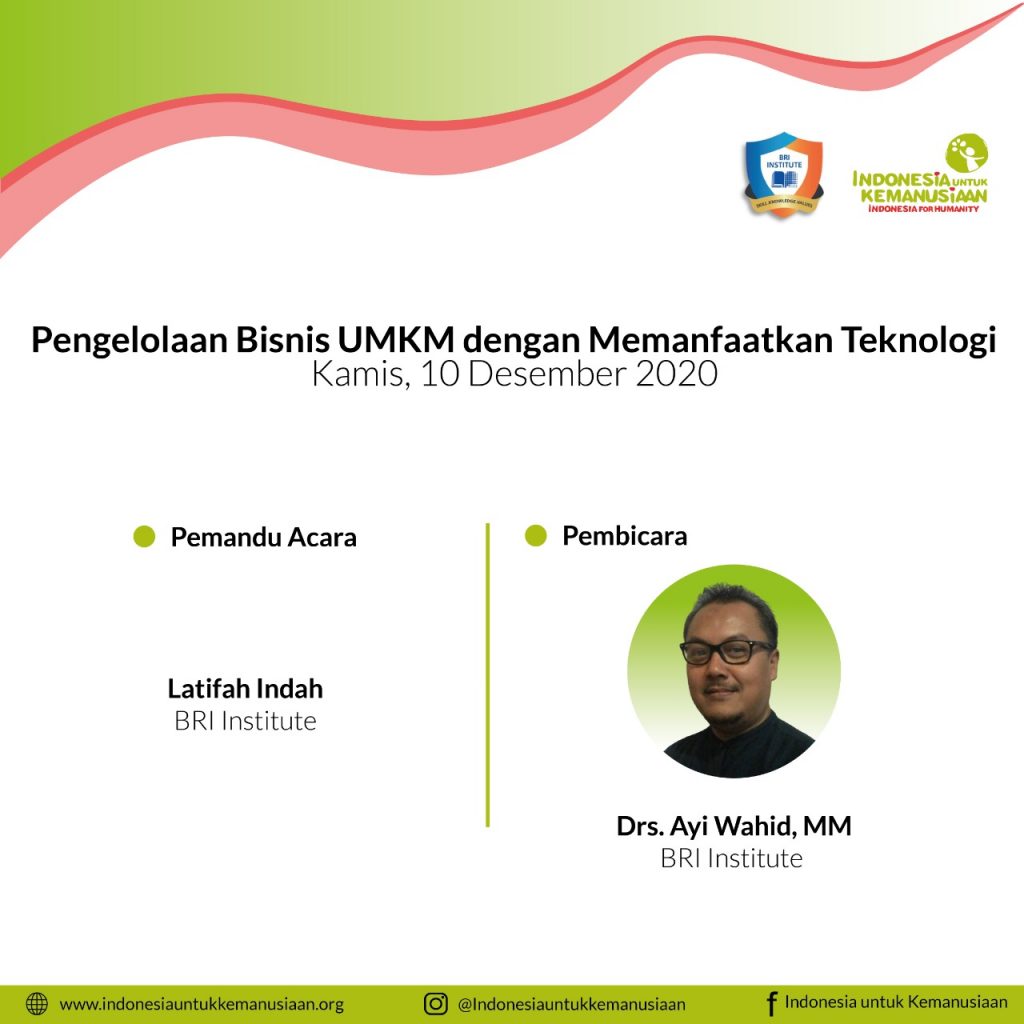
The series on capacity building as well as community service collaboration between the BRI Institute and Indonesia for Humanity (IKa) was held again. The fifth series in this capacity building series features Ayi Wahid as a speaker from the BRI Institute. One special thing in this fifth capacity building series was the presence of representatives from Circa Handmade and the Community of Ibu Jamu Sragen as IKa partners in the solidarity economy pilot program. In this series, an introduction to financial records for IKa partners is given.
Just as MSMEs are the micro, small and medium business side, the cycle of MSMEs is not far from policy makers, the market sector cycle and the MSME cycle. Broadly speaking, the MSME business and other crowdfunding are related to funds.
Talking about funds is not far from bookkeeping. Bookkeeping itself is the process of recording company data in a certain way from initial evidence to reporting. Why is recording so important and necessary? Because with the existence of records, it can provide information for business people to plan, control, make decisions on production, prices and other aspects, this can be seen from the financial statements or profit and loss balance of the records, it can analyze company data and profit and loss from production.
In addition to recording, we also need to know who users of financial reports are and their functions. The first is the creditor: decides to make a loan or financing to the entity, the interest or yield rate, and the entity’s ability to settle the obligation at maturity. The second investor: decides to give capital to the entity and the returns The third is owner: the business owner has an interest in financial information to assess the performance of his business. Ayi Wahid (Lecturer at BRI Institute)
What needs to be understood in doing bookkeeping:
Record all cash transactions in the cash book, pay attention to writing dates, descriptions, cash in / out columns and balances
Pay attention to incoming money, note where it comes from
Watch out for money, used for whatever purposes
Save proof of transaction
Pay attention to the match between the cash amount and the typical book ending balance
By sharing knowledge carried out by the BRI Institute and Indonesia for Humanity (IKa), we hope that it can help the community to better understand how MSMEs related to these funds can continue to run with well-planned bookkeeping.
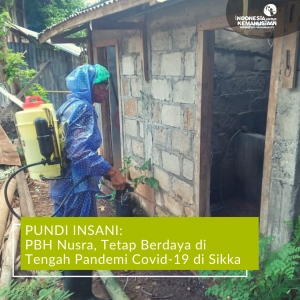
The Nusa Tenggara Legal Aid Association (PBH Nusra) has been experiencing a number of set-backs in the provision of legal aid support to its constituents because of the Covid-19 pandemic. PBH Nusra is responding to the pandemic by providing face-masks, information billboards and holding public education sessions on the dangers of Covid-19.
PBH Nusra’s activities were initiated by a coordinating meeting with the Disaster Risk Management Forum (FPRB) to discuss the management of the Dengue Fever crisis and to anticipate the spread of Covid-19. This meeting took place at the Caritas Secretariat in Maumere diocese on 23 March 2020 with representatives from Caritas, Wahana Tani Mandiri (a farmers’ organization), PBH Nusra, the Regional Disaster Management Agency (BPBD), the Union of Catholic Students of the Republic of Indonesia (PMKRI) the Indonesian Red Cross (PMI).
Pundi Insani provides grants for rehabilitation and empowerment of victims of human rights violations. Currently, Pundi Insani is supported by the Peduli Program which aims to create a socially-inclusive movement to promote equality and dignity.
Pundi Perempuan Covid-19 Grant: “We are in this Together. Let’s Protect Each Other”
Indonesia for Humanity (IKa) via the Pundi Perempuan Covid-19 Grant invites organizations that provide services for Women’s Crisis Centers to submit proposals that support victims of violence that are suffering under the impact of the Covid-19 pandemic. This grant aims to reduce the burden of service provision organizations, in order that they are able to continue to provide services to women victims of violence safely and comprehensively.
Funding Criteria for the Pundi Perempuan Covid-19 grant:
Service providers or women’s crisis centers in Indonesia
Actively provide legal and psycho-social services to women who are victims of violence in the community during the Covid-19 pandemic.
Are not currently in receipt of funding from a national or international donor
Have a clear control system (Board, Executive and Staff)
Include 2 reference from the organization’s network
The Pundi Perempuan grant may be used to support the following needs:
Communications (internet and mobile phone credit)
Transport rental in accordance with Covid-19 health and safety protocols
Supplements and nourishing food provisions to ensure the health of support staff
Disinfectant, masks and other Personal Protection Equipment (PPE)
Payment for medical and psychological professional services for support staff
Other relevant necessities that enable staff to work during the Covid-19 pandemic
Mechanisms for disbursement of the Pundi Perempuan Covid-19 Grant
Successful applicants will be informed via email and Indonesia for Humanity’s social media
The selection of the successful Pundi Perepuan grant applicants will be done by Indonesia for Humanity in partnership with the National Commission for Women
The Pundi Perempuan grant will be disbursed to the successful applicants up to December 2020.
The service providers and/or women’s crisis centers should submit a proposal for activities covering a period of 3 months and include the following information:
A. Organizational/Community Information
1. Name of the organization/community:
2. Name of organization/community leadership:
3. Address:
4. Email and Telephone:
B. Summary of the proposed activities
1. Title
2. Time period (maximum 3 months)
3. Budget requested (maximum 20 million rupiah)
4. Nama of the person responsible for the program (address, email and telephone)
5. Two references (names, email and contact details)
C. Proposal
1. Background/introduction
Explain the conditions the organization is facing in its area of operations whilst continuing to provide services to women who are victims of violence during Covid-19
2. Aims, expenditure, and targets that will be implemented using support from the Pundi Perempuan grant
3. What activities are planned in order to address the issues faced and attain proposed targets
4. Summarize the threats and opportunities that will be faced during the implementation of the activities and who the organization plans to overcome these threats
D. Budget
Include a budget line per activity. For example, the provision of rapid test for women victims of violence in order to be admitted to a safe house: 400 thousand rupiah.
E. Appendices
1. Organizational profile
2. Organizational structure
3. Photocopy of the bank account in the name of the organization or a photocopy of the business account together with the names of two people who are part of the structure of the organization/community The successful applicants are expected to send activity and financial progress reports along with other supporting information in accordance with the format provided by Indonesia for Humanity in its position as manager of the Pundi Perempuan grant
Announcing the call for proposals by Indonesia for Humanity (IKa), in collaboration with Indonesia Berseru Association and Terasmitra for communities and activists working on food sovereignty in Indonesia. The grants will be allocated to communities/groups that work on the environment, support food sovereignty and community food system planning that is fair, sovereign and sustainable.
Groups and communities are invited to take part in the 2020 Pundi Hijau Grant selection process by submitting planned activities. The grant will be allocated over three periods, as follows:
Term 1: 3 July 2020
Term 2: 31 July 2010
Term 3: 25 September 2012
Successful applicants of the Pundi Hijau grant will be selected in accordance with the following criteria:
Local seed-bank communities
Communities wishing to strengthen local food production systems
Communities providing technical support
Communities that implement a clear and controlled operational system
Located in towns/villages in Indonesia
Do not yet have access to large donors
Include two references from their networks
Planned activities will be selected by a committee with representatives from Indonesia for Humanity (IKa), the Indonesia Berseru Association and Terasmitra. Announcement of successful applications will be made on the following dates: 3 July 2020, 31 Julu 2020 and 25 September 2020.
Successful applicants will receive funding between 2-5 million rupiah.
Proposals may be sent to pundihijau@indonesiauntukkemanusiaan.org.
Pundi Hijau is a forum for raising and managing resources (grants, knowledge, networks and volunteerism) to support food self-reliance as a response to the food crisis caused by the Covid-19 pandemic.
PIC: Ikhwan (0811929383)
How to submit a call for proposals
Guide to writing a proposal for the Pundi Hijau program
A. Organizational/Community Information
1. Name of the organization/community:
2. Name of the organization/community leaders:
3. Address:
4. Email and Telephone
B. Summary of the proposed activities
1. Title
2. Duration of activities
3. Budget requested
4. Name of the person responsible for the program (address, email and telephone)
5. Two references (names, email and contact details)
C. Proposal
1. Background/introduction
Explain the conditions the organization is facing in its area of operations and the problems faced. Give the names of individuals and organizations that have been involved (tell us about your network, whether you have received support in the past be it a financial grant or in-kind).
2. Information about the planned activities and how they will help to address the issues
3. Provide a short summary of the threats and opportunities that will be faced during the implementation of the activities and who the organization plans to overcome these threats
D. Budget
1. Include budget lines per activity uni.
2. Example: Purchase of bamboo fence, 10 bamboo poles @10,000 Rupiah per pole = 100,000 Rupiah
E. Appendices
1. Organizational profile
2. Organizational structure
3. Photocopy of the bank account in the name of the organization or a photocopy of the business account together with the names of two people who are part of the structure of the organization/community Activity plans me by submitted to info@indonesiauntukkemanusiaan.org
Jakarta, 16 May – Indonesia for Humanity (IKa) and the National Commission for Women launched the Pundi Perempuan Online Donations for Women Victims of Violence in the Midst of Covid-19 on Friday 5 June 2020. This movement has been initiated to support service provision organizations and women’s crisis centers so that they can continue their work providing legal assistance and counselling services to women victims of violence.
Keynote speaker, Professor Dr. Vennetia Ryckerens Danes, Deputy of the Ministry for Women’s Empowerment and Child Protection Women’s Right Protection Unit, explained that online donations were an appropriate way to increase to support services provision organizations in the midst of the pandemic.
“Collecting donations online is an appropriate way to increase support for service providers to anticipate obstacles that will arise because of the pandemic to providing support for women victims of violence,” said Professor Vennetia.
The launch was followed by a talk show with the theme “We are in it Together. Let’s Protect Each Other” with speakers including Cinta Laura Khiel (Anti-Violence Against Women Ambassador for the Ministry for Women’s Empowerment and Child Protection), Theresia Iswarini (Commissioner, National Commission for Women), Lilik H.S. (Pundi Perempuan, IKa) and Ayu Kartika Dewi (Presidential Staff) as moderator.
According to Theresia Iswarini, the results of the National Commission for Women’s survey show a steep rise in incidents of domestic violence during the Covid-19 pandemic and the implementation of the Large-Scale Social Distancing (PSBB) policy.
“During the pandemic and since PSBB was implemented, the ability of victims to leave their homes to avoid abuse has been reduced. The victims have to prioritize many things. They prioritize staying at home, providing food and clothing as well as mobile phone data so that they children can learn online,” said Iswarini.
The reluctance to report cases also impacts on the organizations that provide services, who are on the frontline in ensuring that support can still be provided, both online or offline.
Challenges to service provision during Covid-19 are also financial in nature. Communications costs have risen because of the increase of online provision. Support organizations have to adjust their budgets – some have sufficient funding and some don’t.
“The public need to be aware that it is important to increase our concern and support for service providers. Working as they do on the frontlines, if they don’t have the means to provide support – communication costs, fast internet speeds and as well as the relevant technology and ‘gadgets’ they won’t be able to support victims. We need to support them,” added Iswarini.
“Pundi Perempuan is committed to help address these conditions by providing support to organizations that provide services to women and women’s crisis centers. The support is intended to empower the organizations, it isn’t charity. Pundi Perempuan will try to raise awareness of the importance of women’s crisis centers and service providers, because as levels of abuse increase, so must support,” said Lilik HS
According to Lilik, these efforts won’t succeed without the involvement of many different parties. Violence against women is a national issue, a global issue. Women are the future of civilization. Women must have full access to justice as citizens of Indonesia.
Cinta Laura Khiel also emphasized the importance of this. She explained that the involvement of many different parties is needed in order to truly support women victims of violence.
“We can help women victims of violence by donating. Our donations can provide a lot of support for women, because organizations in Indonesia that help women are short of funding,” said Cinta.
Cinta also expressed her hope that young people are aware that they must speak up, “If we speak up, the younger generation can do more to help raise awareness, that abuse and violence is wrong. We need to respect one another if we are to progress,” added Cinta. The discussion was closed by Ayu Kartika Dewi, who said that violence against women was a systemic problem, and that we can contribute to addressing this issue by donating to funding for victims and their support organizations. It is hoped that this movement can be broadened and more can be done by every sector and at every level of society.